Can You Monetize AI Voiceover Videos on YouTube? (2026 Rules)
Short answer: yes, you can — but the voice alone doesn't decide it. YouTube monetizes channels, not narration methods. What decides approval is whether your videos add original value for viewers. An AI-narrated video with original scripts, real commentary, and genuine editing effort can pass review; a channel pumping out robotic readings of scraped articles cannot.
This question comes from fear, and it's a fair fear. Plenty of creators have been rejected from the YouTube Partner Program (YPP) over "reused content" — and many of them were using AI voices. This article separates what YouTube's rules actually say from the rumors, so you can decide whether AI narration fits your channel strategy.
What YouTube's Rules Actually Say About AI Content
YouTube does not have a blanket ban on AI-generated voices. What it does have is a long-standing reused content policy: to join the YouTube Partner Program, your channel must produce original content, or add significant original commentary and educational value on top of third-party material.
The key phrase is "original commentary or value." The policy was written to stop content-farm channels that reupload other people's videos, but it applies equally to AI-generated material. In plain terms: if your video could have been made by anyone with the same input — same stock footage, same AI voice, same public-domain script — it's at risk. If it reflects your judgment, research, structure, and taste, it's on safer ground.
A few more things that matter:
- YPP review is manual. A human reviewer watches a sample of your channel's videos. If the channel looks like mass-produced filler, the voice being synthetic is only one signal among many.
- AI disclosure: YouTube asks creators to disclose realistic synthetic content that could mislead — e.g., a real person appearing to say something they didn't. An AI voiceover narrating your own original script is a different case.
- Policies evolve. YouTube updates its monetization policies periodically, and AI-specific guidance is still being refined. Treat this article as a snapshot and check YouTube's current Partner Program policies before building your strategy.
What Actually Gets Rejected
Rejections aren't about the voice technology; they're about effort-to-value ratios. These patterns consistently fail YPP review:
- Robotic readings of scraped or copied articles. Taking a Wikipedia article or a news piece, pasting it into a text-to-speech tool, slapping stock footage over it, and uploading — that's the textbook case of "content that adds no original value." Reviewers reject it routinely.
- Mass-produced, low-effort compilations. Dozens of near-identical videos per week — "Top 10 Facts About X" templates with the same visuals and pacing. Even with good narration, the pattern signals a content farm.
- Misleading content. Videos that imply something the AI didn't do — a fake celebrity voice endorsement, fabricated quotes, or "documentary" claims with no sources. This can trigger both monetization rejection and removal.
- Channels where the voice is the only "content." If everything on screen is stock footage and every word is a rephrased public article, there's no human contribution for the reviewer to find.
Notice that none of these are about the voice sounding synthetic. A human narrating the same lazy compilation gets rejected just the same.
What Gets Approved
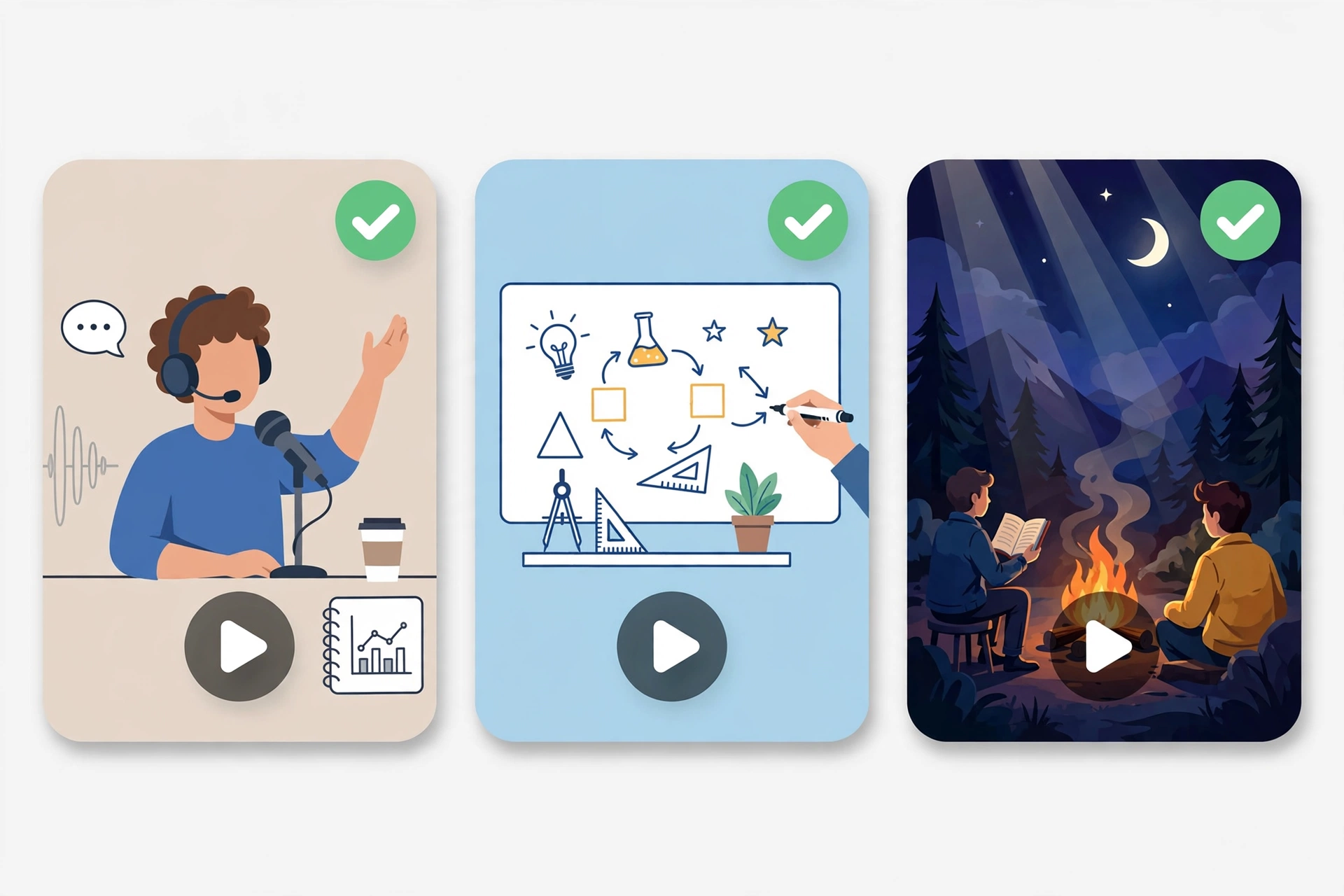
Channels using AI narration do get monetized when the rest of the package shows genuine creative work:
- Original scripts written for the video. Research, structure, pacing, and a point of view — the narration is your words, just spoken by a synthetic voice. This is the single biggest factor.
- Real commentary and analysis. Explainers, opinions, storytelling with a narrative arc, breakdowns of complex topics — anything where your thinking is the product.
- Educational value. Tutorials, documentaries, science explainers, and history videos do well when the script is original and sourced, regardless of who reads it.
- Genuine editing effort. Custom visuals, animations, motion graphics, B-roll selected with intent, sound design. If a reviewer can see the hours, the voice choice stops mattering.
The pattern is simple: the AI voice is a tool, not a substitute for the creative work. Treat it like hiring a voice actor — the script, editing, and direction are still yours.
Best Practices Checklist for AI-Voice Channels
If you're building a channel around AI narration, this is the checklist that keeps you on the right side of review:
- [ ] Write original scripts. Never narrate copied text. Write every script yourself (or write it with AI assistance and heavily edit it — then verify the facts).
- [ ] Add real visual effort. Edit like you care: custom graphics, matched B-roll, motion, captions. Stock footage is fine as raw material; stock footage as the whole video is not.
- [ ] Pick a consistent, quality voice. Channels with a recognizable voice build audience trust. A natural-sounding voice that matches your niche — documentary-calm, finance-authoritative, storytelling-warm — matters more than having dozens of options. If you're testing voices, use a platform with a live demo and a real voice library (SynVoice offers 38,000+ premium AI voices across 100+ languages, including Urdu, Hindi, Arabic, and Punjabi) so you can compare before committing.
- [ ] Disclose AI use where it's appropriate. In descriptions or video notes, a simple line like "Narrated with AI voiceover" builds trust. It's not always required, but transparency costs you nothing and protects you from accusations.
- [ ] Own one niche. Reviewers look at your channel as a whole. A coherent channel about one topic reads as a creator's project; a scatter of random topics reads as a farm.
- [ ] Add a human touchpoint where you can. An on-screen intro, your own writing style coming through, pinned comments, community posts — anything that shows a person runs this channel.
- [ ] Keep quality over quantity. Five strong videos a month will pass review; fifty thin ones won't. YouTube's algorithm also rewards retention and satisfaction, which thin videos destroy.
- [ ] Re-check policy before applying. Read the current reused content and YPP requirements the week you apply. Rules change; don't rely on last year's advice.
How AI Voice Fits a Sustainable Channel Strategy
Honesty requires saying this plainly: AI narration is not a shortcut to passive income. The creators who win with it are the ones who would have succeeded with a human narrator too — they just cut cost and production time.
Where AI voice genuinely helps a sustainable strategy:
- Lowering production cost. You skip studio time, recording sessions, and re-records. Script changes become a regenerate, not a reshoot.
- Consistency. The same voice on every video, forever — no sick days, no mic quality drift.
- Multilingual reach. One script can become videos in multiple languages without hiring narrators in each.
- Iteration speed. Testing hooks, rewrites, and formats gets dramatically faster when narration isn't a bottleneck.
What it can't do: replace the thinking. Script quality, topic selection, and editing are still the moat. Treat the voice as infrastructure — like your editing software or your mic — and put your effort where the value lives: ideas people want, explained well.
If you're starting out, test a few voices on your actual scripts before committing to one. A free trial with a live demo lets you hear exactly how a voice handles your niche's vocabulary — try it at synvoice.io — and check the pricing to confirm the plan starting point fits your budget (plans start from $3.99).
Frequently Asked Questions
Does YouTube demonetize videos just for using AI voiceover?
No — there is no policy that demonetizes a video solely because the narration is AI-generated. Rejections happen under the reused content policy when the channel as a whole shows low original value. The voice is one signal among many, and it's the surrounding creative effort that decides the outcome.
Do I need to disclose that my videos use AI voiceover?
YouTube's disclosure requirement targets realistic synthetic content that could mislead viewers — like a fabricated quote from a real person. A standard AI voiceover narrating your own original script isn't what that rule was written for. That said, a short disclosure in your video description is good practice: it's honest and preempts viewer complaints.
Can I use AI voice for a faceless channel and still get monetized?
Yes. Faceless channels are a normal part of YouTube and are monetized all the time. What matters is that the videos demonstrate original work: original scripts, commentary, editing, and research. Faceless + AI-narrated is fine; faceless + AI-narrated + low-effort is not.
Is it safer to use a human voice actor instead?
It's not the voice that makes a channel safe — it's the effort. A human reading scraped articles over stock footage gets rejected just like an AI doing the same. And a human re-recording every script revision costs more and takes longer. The safer investment is in script quality and editing, whichever voice you use.
How much does it cost to get started with AI voiceover for YouTube?
Far less than hiring voice talent. Most AI voice platforms, including SynVoice, start around a few dollars a month with free trials to test quality first. Budget mainly for your time — scripting and editing — and treat the voice subscription as a minor production cost.