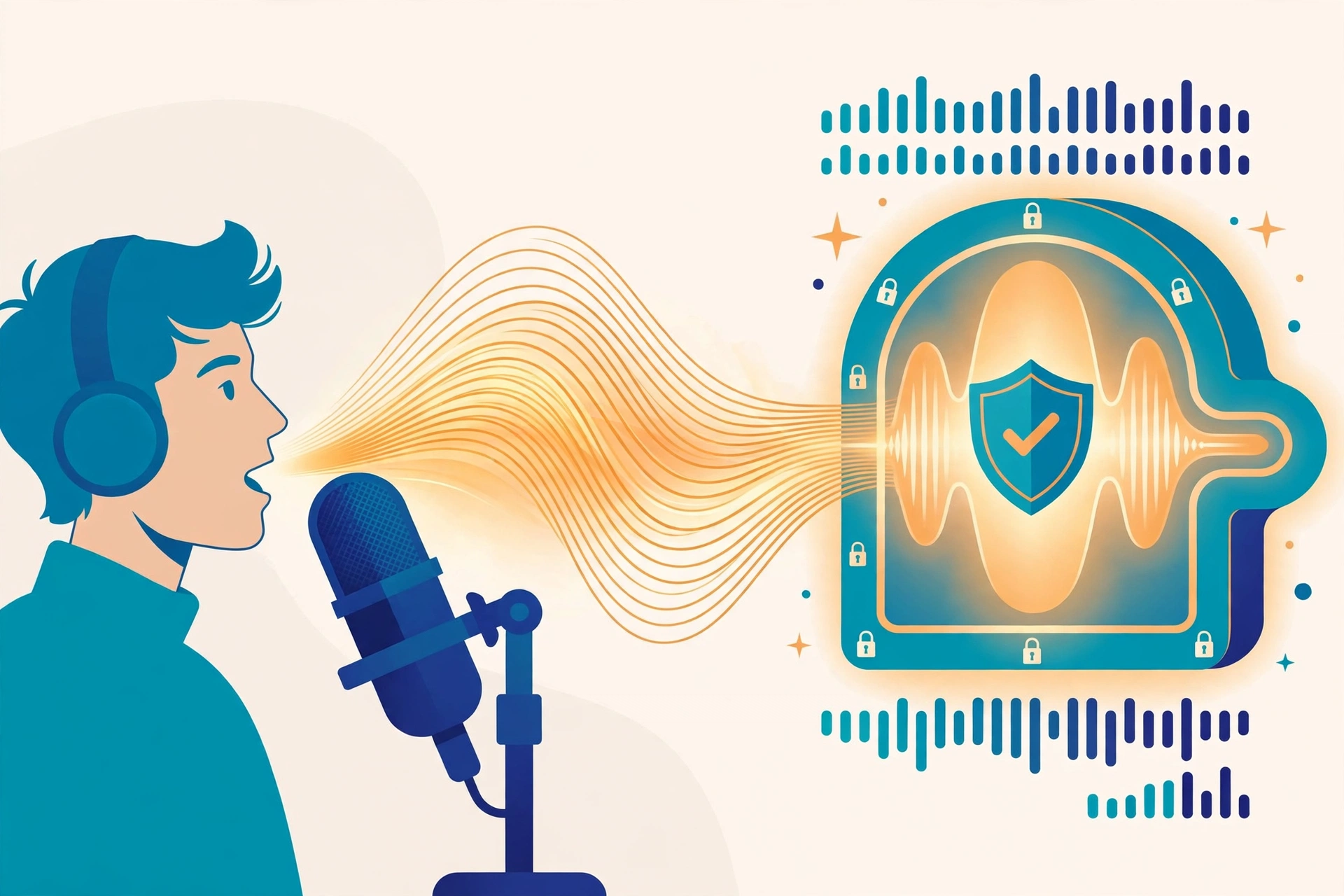
TL;DR: Voice banking records your voice now so a synthetic version can speak for you later if illness or injury takes your speech away. You read sentences into an app, the recordings train a personal voice model, and it speaks typed text in your voice. Start early, record in a quiet room, and keep your recordings safe.
Your voice is one of the most personal things you own — your accent, your humour, your way of saying a child's name. Most of us never think about losing it, until a diagnosis, a stroke, or a progressive condition makes it a real possibility.
Voice banking is the answer to that possibility. It is a simple idea with a powerful result: record your voice while you still can, and a computer model learns to speak in your voice later. This guide walks through the whole process — who it helps, how it works, what recording involves, what it costs, and how to keep your banked voice safe.
What Is Voice Banking?
Definition: Voice banking is the process of recording a person's speech — usually several hundred to a few thousand sentences — to create a personalised synthetic voice that can speak typed text aloud in that person's own voice when they can no longer speak naturally.
The recordings are used to train a voice model. That model is then loaded into a communication app or device, where the person types what they want to say and the device speaks it in their voice. If you are new to the concept, our explainer on what voice banking is covers the basics before this guide gets practical.
Voice banking is not voice cloning for entertainment. Its purpose is communication, not impersonation: the person banking their voice controls it, and it is used only by them — or by someone they have chosen — to speak on their behalf.
Who Should Consider Banking Their Voice?
Anyone whose speech may be affected in future should think about it, but some groups benefit most:
- People with ALS / motor neurone disease — speech loss is common as it progresses, and the recording window can close quickly, so banking soon after diagnosis is the standard advice.
- People with Parkinson's disease, whose speech often becomes quieter and less clear over time.
- People with multiple sclerosis, whose speech can change unpredictably during relapses — bank while speech is stable.
- People facing head and neck surgery, where surgery, radiotherapy, or a laryngectomy can change or remove the voice entirely.
- People with progressive conditions affecting speech — any condition where speech is expected to worsen, including some forms of dementia and stroke risk.
- Older adults who simply want a backup — you do not need a diagnosis; some people bank their voice as a precaution, the way others write a will.
The single most important rule is timing: bank your voice while it still sounds like you. Waiting until speech is already affected means the model learns the affected voice, not the natural one. If you have a diagnosis, start within weeks, not months.
How Does Voice Banking Actually Work?
The process has four stages, and most of them are straightforward:
- Record. You read a set of sentences aloud into a phone or computer, in a quiet room. The app guides you sentence by sentence.
- Train. The recordings are processed into a voice model — a digital picture of your pitch, rhythm, and accent.
- Deliver. The finished voice is installed in a communication app or speech-generating device.
- Speak. You type a message and the device reads it aloud in your voice — including, in some systems, your own recorded phrases for common expressions.
Definition: A voice model is the trained digital version of a person's voice. It is built from their recordings and can generate new speech in that voice — any sentence, not just the ones that were recorded.
Modern systems need far less recording than the early ones: today's tools can build a usable voice from a short session, some from as little as a few minutes of clear speech. The trade-off is quality — more recording generally means a more natural, more flexible voice.
How Much Recording Does a Good Voice Bank Need?
The amount of recording depends on the method you choose. This table gives a realistic picture:
| Method | Recording needed | Voice quality | Best for |
|---|---|---|---|
| Full voice banking (sentence set) | 1,000–1,600 sentences, 1–3 hours | Very natural, most flexible | People with time before speech loss |
| Short-session banking | 100–300 sentences, 15–30 minutes | Good, clear, slightly less expressive | People who need a voice quickly |
| Message banking (key phrases) | 20–100 personal phrases | Your real voice, exact phrases only | Anyone — do this alongside full banking |
| Rapid voice cloning from samples | 1–5 minutes of existing audio | Varies; depends on audio quality | People who already have recordings |
The numbers are a guide, not a rule: some providers ask for a fixed script of around 1,600 sentences; others build the best voice possible from whatever you record. If your energy is limited — common with ALS — record in short sessions of ten or fifteen minutes. A complete recording done over two weeks beats an exhausting single afternoon.
Message banking deserves special attention: you record specific phrases in your real voice — "I love you", your children's names, a favourite joke — and those exact recordings play back when you choose them. No synthesis, so the result is unmistakably you. Do it first, on day one — it needs no training time and captures the phrases that matter most. Our step-by-step walkthrough on how to record your voice for voice banking covers the practical setup in detail.
What Does a Voice Banking Session Look Like?
A typical session is calmer than people expect:
- Pick a quiet room. Turn off fans, close windows, silence notifications. Background noise is the biggest enemy of a good voice model.
- Use a decent microphone. A headset microphone or a USB microphone beats a laptop's built-in mic. Keep the microphone at a steady distance — about a hand's width from your mouth.
- Warm up. Read a few sentences aloud, drink some water, and settle into your natural pace. Do not try to sound formal — the model should learn how you actually talk.
- Record sentence by sentence. The app shows a sentence; you read it, then move on. Speak naturally, at your normal speed, with your normal expression. If you stumble, re-record that sentence — most apps make this one tap.
- Take breaks. Ten to fifteen minutes of recording, then a pause. Your voice tires, and tired recordings make a tired-sounding model.
- Review and submit. Listen to a few samples, re-record anything that sounds wrong, then submit the set for training — usually hours to a few days.
The script you read matters. Good scripts cover a wide range of sounds — every vowel and consonant combination your language uses — plus numbers, names, questions, and emotional phrases. Providers supply the script, so you do not need to write one. If you are just getting started, our guide to starting voice banking explains the first steps and what to expect from the process.
How Do You Choose a Voice Banking Provider?
There is no single best provider — the right choice depends on your condition, timeline, budget, and the device you will use to speak. Compare on these points:
| Factor | What to look for | Why it matters |
|---|---|---|
| Recording time required | Short sessions vs. full script | Energy and time available |
| Voice quality | Listen to samples of banked voices | A natural voice is easier to listen to all day |
| Device compatibility | Works with your AAC app or device | The voice must run where you communicate |
| Cost | Free, one-off fee, or subscription | Costs vary widely; some charities fund it |
| Data ownership | You own the recordings and the model | You should control who can use your voice |
| Support | Human help during recording | Recording is harder when you are unwell |
| Turnaround | Hours vs. days vs. weeks | A fast result matters when time is short |
Before committing, ask each provider three questions: who owns my voice model, can I move it to a different app later, and what happens to my recordings if the company closes? The answers tell you more than any feature list. Consent and security matter enormously with a personal voice — our guide to voice banking security explains the risks and the protections to insist on.
In many countries, ALS associations, speech therapy services, and disability charities fund voice banking or lend recording equipment, and some providers bank voices free for people with a diagnosis.
How Is a Banked Voice Used Day to Day?
Once ready, the voice lives in a communication app — often called an AAC app — on a tablet, phone, or speech-generating device. Using it is simple: type a sentence, tap speak, and the device reads it in your voice.
Most users combine three tools:
- The banked voice for everyday typed speech — conversations, questions, instructions.
- Message banked phrases for the things they say most — greetings, names, jokes, "I love you" — in their real recorded voice.
- Quick phrases and prediction built into the app, so common sentences take one tap instead of full typing.
The first week takes adjustment — typing is slower than speaking, and conversations find a new rhythm. But most users say the same thing: hearing their own voice, even a synthetic one, makes communication feel like theirs again, instead of borrowing a stranger's voice. Family members notice the difference immediately.
How Much Does Voice Banking Cost?
Costs vary widely, and for many people the answer is nothing:
- Free options exist. Some providers bank voices for free for people with a diagnosis such as ALS, and several charities cover the cost entirely.
- Paid services typically charge a one-off fee or a monthly subscription, often a few hundred dollars for a full voice — prices vary, so always check the current price before starting.
- Charity and health-service funding is common. Ask your speech therapist, your ALS association, or your local disability service before paying anything yourself.
- Message banking is usually free. Recording key phrases needs only a phone and an app, so there is no reason to delay it.
Do not let cost delay the recording itself — the model can be built later from recordings you already made. If a provider charges for training but not recording, record now and decide on training when you are ready. Our cost breakdown on voice banking costs gives current figures and funding routes.
How Do You Keep a Banked Voice Safe?
A banked voice is biometric data — it is as personal as a fingerprint. Protect it accordingly:
- Keep a backup of your recordings, stored somewhere safe and separate from the provider — if it disappears, your recordings are the only way to rebuild the voice.
- Use strong consent controls: only you — or someone you have formally chosen — should be able to authorise use of your voice.
- Be cautious about sharing: a voice model can, in principle, be made to say things you never said. Never share the model file casually, and treat requests to use your voice like requests for your signature.
- Check the provider's data policy: where recordings are stored, who can access them, how long they are kept, and how to have them deleted.
- Plan for the future: write down who should control your voice if you can no longer manage it, and tell your family where the recordings are stored.
When Is the Right Time to Start?
The honest answer is: now, if there is any reason to think your speech might change. Voice banking is one of the few preparations where starting early costs almost nothing and starting late can cost everything.
A practical timeline: this week, record your message banked phrases — the names, greetings, and expressions that matter most. This month, choose a provider and start the full recording in short sessions. Within a few weeks you will have a voice model ready, whether you need it next month or in five years — and if you never need it, you have lost nothing but a few hours of reading aloud.
If someone you love has just received a diagnosis that may affect their speech, the kindest thing you can do is raise voice banking early — gently, and soon. Most people who bank their voice say the same thing afterwards: they wish they had started sooner, and they are glad they did.
Frequently Asked Questions
How long does voice banking take from start to finish?
Recording takes one to three hours spread over short sessions, and training takes a few hours to a few days. From first recording to a working voice, expect one to two weeks, though some services deliver within 48 hours.
Can I bank my voice if my speech is already affected?
Yes, but the result will reflect your current speech. Providers can still build a usable voice from affected speech, and message banking works even when longer sessions are tiring. Bank as early as you can — but do not assume it is too late until a provider has assessed your recordings.
Is my banked voice the same as voice cloning?
They use similar technology, but the purpose and consent are different. Voice banking creates a voice for the person themselves to communicate with, under their control. Voice cloning usually means copying someone else's voice, often for media or entertainment. The technology overlaps; the intent and the consent do not. See our comparison of voice banking vs voice cloning for the full distinction.
What happens to my banked voice after I die?
That depends on the provider's policy and what you arranged: some delete the voice on request; others let a family member keep it for personal use, such as reading stories to children. Decide in advance, write it down, and make sure your family knows your wishes and where the recordings are stored.
Do I need special equipment to bank my voice?
No. A smartphone and a quiet room are enough to start, and most providers' apps guide you through recording. A headset or USB microphone improves quality noticeably, but do not delay recording while waiting for equipment — a phone recording made today beats a perfect recording that never happens.
Can children bank their voices?
Yes, with a parent or guardian's consent. Sessions are shorter and scripts adapted for children, but the process is the same.
Can I use my banked voice on any device?
Most providers support the common AAC apps and major platforms, but not every voice works everywhere. Check compatibility with your app or device before recording, and ask whether you can move your voice to a different app later.
Banking your voice is a gift to your future self — and to the people who love hearing you speak. Start with a few phrases today, and build the full voice while your voice is still unmistakably yours. For more on who benefits most, see our guides to voice banking for ALS patients and for people with Parkinson's.