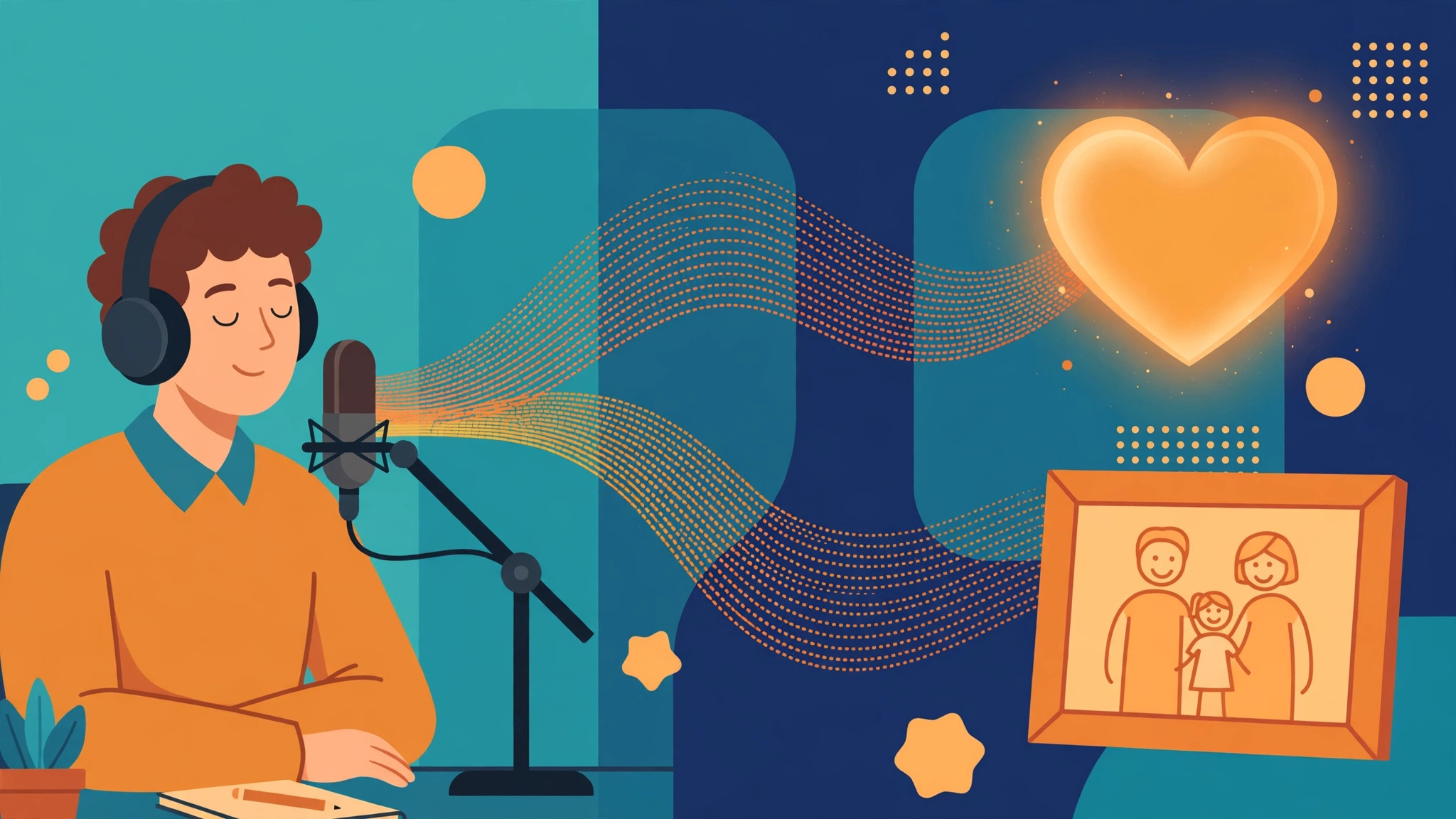
TL;DR: Voice banking lets people with ALS record their voice now, so a speech device can speak in their own voice later — even after speaking becomes hard or impossible. Start right after diagnosis, while speech is still clear. This guide covers how it works, what to record, what it costs, and how to use your banked voice.
ALS changes many things, but the first loss most people fear is not movement — it is being heard as themselves. Speech is how we joke with a partner and comfort a child. When ALS begins to affect the muscles that shape speech, those everyday moments get harder. Voice banking protects them in advance: you record your voice while it is still strong, and that recording becomes the voice your communication device uses later.
Most people complete the core recording in a few short sessions at home, using a phone or a laptop. This guide covers what voice banking is, why timing matters with ALS, what to record, what it costs, which services people use, and how the finished voice works on a device.
What Is Voice Banking for ALS Patients?
Definition: Voice banking is the process of recording a person's speech — usually a set of sentences read aloud — so that a computer can build a synthetic version of that person's voice. For someone with ALS, the banked voice can later be loaded onto a speech-generating device, which speaks typed messages aloud in the person's own voice instead of a generic one.
The effect is profound. A generic synthetic voice says the words; your banked voice says them the way you would — your accent, your rhythm, your laugh in the phrasing. Family members say the difference matters most in ordinary moments, not formal speeches.
Voice banking is different from message banking, though the two work well together. Message banking means recording whole phrases you use often ("I love you", "good morning") in your natural voice, so you can play them back exactly as recorded. Voice banking goes further: it builds a flexible voice that can say anything you type, including words you never recorded.
New to the idea? Our beginner's guide walks through the basics:
How to Start Voice Banking: A Complete Beginner's Guide
Why Should You Start Voice Banking Right After an ALS Diagnosis?
Timing is the single most important factor in voice banking, and ALS makes it urgent. ALS affects the motor neurons that control the muscles used for speaking, and most people notice changes as it progresses — slurring, slower pace, quieter volume, or a voice that tires quickly. The recordings used to build a banked voice work best when speech is still clear and consistent.
That does not mean you should panic. It means you should treat voice banking like any other early decision after diagnosis: worth doing soon, while it is easy, rather than later, when it may be hard or impossible. Speech therapists often raise it at the first appointment after diagnosis, because the window of clear speech is unpredictable — some people keep clear speech for years, others notice changes within months.
Starting early also removes pressure: recording takes a few hours spread over several days, and it is far easier to do while you feel well. A banked voice is not only for the person with ALS — partners, children, and grandchildren hear that voice for years afterwards.
How Does Voice Banking Actually Work?
Definition: A voice bank is built from recorded speech samples that a speech-synthesis system analyses for pitch, tone, rhythm, and pronunciation, so it can generate new speech in your voice from any typed text.
The process has three stages, and you only have to do the first one yourself.
Step 1: You record. A service gives you a list of sentences to read aloud — typically several hundred, chosen to cover the full range of sounds in your language. You record them in a quiet room, speaking naturally, at your usual pace. Most services let you pause and resume, so you can record in short sessions of 10–20 minutes.
Step 2: The service builds your voice. The recordings are processed by speech-synthesis software, which creates a voice model. This usually takes a few days. You may be asked to listen to a sample and approve it, or to record a few extra sentences to improve a weak spot.
Step 3: You use the voice. The finished voice is loaded onto a speech-generating device or app — a tablet, a dedicated device, or a phone. You type what you want to say, and the device speaks it in your voice. Eye-gaze control, switch access, or a touchscreen can all drive it, so it keeps working as physical abilities change.
Voice banking is sometimes confused with voice cloning, which uses the same underlying idea. The practical difference for ALS is the purpose: voice banking is a medical and communication decision, made early, with services built for people whose speech is changing. If you want to understand the cloning side in more depth, this guide explains it:
AI Voice Cloning for Podcasters: Keep Your Voice on Every Episode
What Do You Need to Record for a Good Voice Bank?
You do not need a "nice" voice — you need to sound like yourself. The sentences capture the sounds of your language, not to test you, and the software does the hard work of turning them into a voice.
The table below shows what a typical recording session covers.
| What you record | Examples | Why it matters |
|---|---|---|
| Everyday sentences | "The weather is nice today", "I would like a cup of tea" | Covers common words and sentence melody |
| Sound-rich sentences | Sentences packed with varied consonants and vowels | Teaches the system every sound your language uses |
| Questions and exclamations | "Are you coming home soon?", "That was wonderful!" | Captures rising and falling intonation |
| Names and personal words | Family names, places, favourite foods, pet names | Makes sure the voice pronounces your important words correctly |
| Emotional phrases | Greetings, jokes, terms of endearment | Preserves warmth and personality, not just pronunciation |
A few practical tips make the recording much better. Record in the quietest room you have — background noise is the most common reason a voice model comes out muddy. Use the same microphone and distance for every session, speak at your normal speed and volume, and take breaks: a tired voice sounds different from a rested one.
If you have an accent or a regional dialect, do not try to neutralise it. The system learns what you actually sound like. That is the whole point.
How Long Does Voice Banking Take?
Recording takes between two and five hours in total, spread over several short sessions. Some services ask for around 300 sentences; others ask for more than 1,000, which takes longer but can sound more natural.
The full timeline, from first recording to a working voice on a device, is usually one to three weeks: a few days to record, a few days to process, and another session or two to load the voice and learn the communication app, often with a speech therapist.
How Much Does Voice Banking Cost?
Cost is a common worry, and the honest answer is that it varies widely — from free to several hundred dollars — depending on the service and where you live.
| Cost factor | Typical range | Notes |
|---|---|---|
| Charitable / research services | Free | Funded by ALS organisations or universities; may have a waiting list |
| Commercial voice banking | $100–$500 one-off | Includes the voice build and a device licence |
| Communication device or app | Varies widely | Tablets and apps are far cheaper than dedicated devices; check insurance |
| Speech therapy support | Often covered | A therapist can guide recording and setup; coverage depends on your plan |
Before paying for anything, check the cost guide we maintain for this exact question, because prices and free options change:
Voice Banking Cost: What It Really Costs in 2026
Ask any service three questions before you start: is the voice yours forever, or does the licence expire? Does the price cover every device you might use, or only one? If your speech changes and you need to re-record, is that included? The answers matter more than the headline price.
Insurance and ALS organisations can help. Some health plans cover communication devices and their software, though coverage for the voice itself varies. ALS associations in many countries keep lists of funded or discounted options — worth one phone call before you pay out of pocket.
Which Voice Banking Services Work Best for ALS?
There is no single best service for everyone with ALS — the right choice depends on your language, budget, recording time, and which communication device you will use.
Specialist voice banking services for ALS. These are built specifically for people whose speech is changing. They usually ask for fewer sentences than general cloning tools, give clear guidance on recording quality, and work directly with speech therapists and communication-device companies. ModelTalker, a long-running project from Nemours, is the best-known example.
Commercial voice cloning platforms. General-purpose AI voice tools can also create a voice from a short recording, and some people with ALS use them because they are fast and easy to start. The trade-off is that they are not designed around changing speech, so they offer less guidance on when to record and how to handle a voice that is already changing.
Communication-device makers' own voices. Some makers of speech-generating devices offer their own voice banking as part of the device package, so the voice arrives already loaded and tested on the hardware you will use. If you already know which device you will use, ask the supplier whether they include voice banking — it can save a complicated transfer step later.
Whichever route you choose, check three things before you commit: that the voice can be exported to the device or app you will actually use, that you keep ownership of your recordings and your voice model, and that there is a way to get help from a real person if the recording or the setup goes wrong.
How Do You Use Your Banked Voice on a Communication Device?
Once built, your voice lives on a speech-generating device — the tool that turns typed words into spoken ones. It simply plays whichever voice is loaded.
| Device type | How your banked voice is used | Best for |
|---|---|---|
| Tablet with a communication app | Voice loaded in the app; type or tap to speak | Most people starting out; familiar and affordable |
| Dedicated speech-generating device | Voice built in; touch, switch, or eye-gaze control | People who need eye-gaze control or a rugged device |
| Phone with a text-to-speech app | Voice in the app for quick messages on the go | Short conversations and everyday errands |
Learning to use the device takes a little practice, and it is worth starting that practice before you strictly need it. Most communication apps let you store favourite phrases and organise vocabulary by topic, so common things — greetings, food, pain, feelings — are one or two taps away.
Eye-gaze control deserves a special mention, because it is the access method many people with ALS eventually use. The device watches where you look and types the words you look at. It feels strange for the first hour and natural by the second day, and your banked voice works with it exactly the same as with typing.
Families often worry that a device will feel impersonal. In practice the opposite happens: because the voice is yours, the device disappears into the background and the conversation comes forward.
What If Your Speech Has Already Changed?
This is the question people are most afraid to ask, and it deserves a straight answer. If your speech has already changed noticeably — slurring, slower pace, difficulty being understood by strangers — you can probably still bank a voice, but the result depends on how clear your speech remains and on which service you use. Some services accept recordings from people with mild to moderate dysarthria and still produce a recognisable voice.
The best next step is to ask, not to assume. Send a short voice sample to a voice banking service or to your speech therapist and ask for an honest assessment. Many services will listen to a sample before you commit, and a therapist who works with ALS will know which services accept changed speech.
If full voice banking is no longer possible, message banking is still open to you: recording whole phrases in your own voice preserves the sound of you saying the things that matter most, alongside a synthetic voice for everything else.
Voice Banking for Grandparents: Preserve Your Voice for Your Grandchildren
Frequently Asked Questions
When is the best time to start voice banking with ALS?
Right after diagnosis, while your speech is still clear and consistent. Voice banking works best with clear recordings, and speech changes in ALS are unpredictable.
How much speech do I need to record?
Most services ask for 300 to 1,000+ sentences — roughly two to five hours, spread over several days. Shorter recordings still produce a usable voice; longer ones sound more natural. Record in a quiet room, at your normal pace, and take breaks.
Can I still bank my voice if my speech is already slurred?
Possibly, depending on how clear your speech remains. Some services accept recordings from people with mild to moderate dysarthria. Send a short voice sample to a service or your speech therapist for an honest assessment first. If full voice banking is not possible, message banking is still a valuable option.
How long does a banked voice last?
A banked voice model does not expire. Once built, it can be used for as long as you need it, on any compatible device, and your family can keep it afterwards. Check the licence terms first, to make sure the voice stays yours.
Is voice banking covered by insurance?
It depends on your plan and country. Devices and their software are more commonly covered than the voice itself, but some plans and ALS organisations fund or discount voice banking. Ask your insurer and local ALS association before paying.
Can my family use my banked voice after I can no longer speak?
Yes — that is one of the main reasons people bank their voice. Once loaded on a device, it speaks whatever is typed, so your family can keep hearing your voice in everyday conversation.
What is the difference between voice banking and voice cloning?
Voice banking is voice cloning with a medical purpose: recording your voice early, usually through a service built for people whose speech is changing, so a communication device can speak in your voice later. General cloning tools do the same technical job but are built for creators, not for ALS.