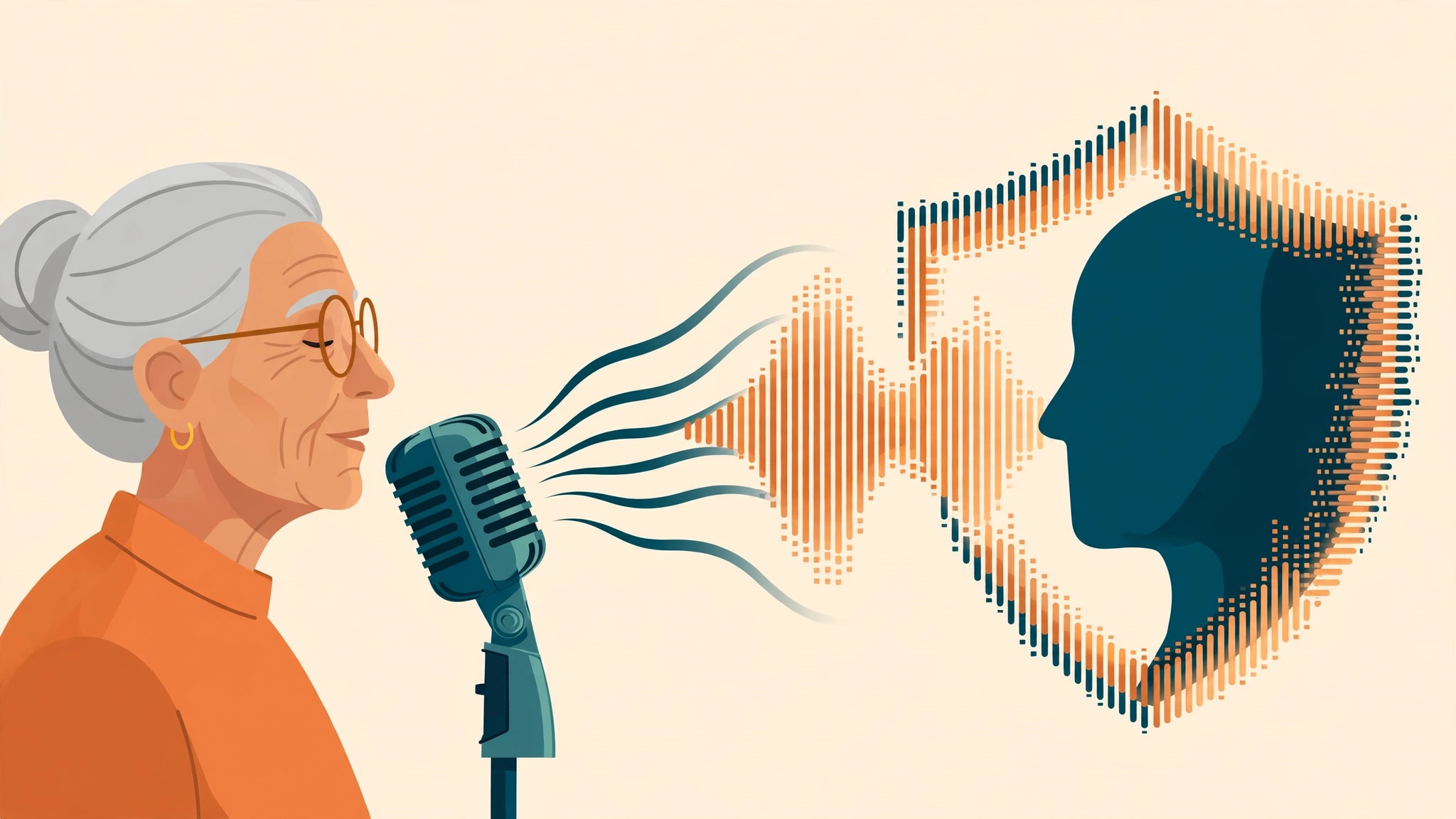
TL;DR: Voice banking for Parkinson's means recording your voice now, while it is still strong, so you can keep speaking in your own voice later if the disease weakens it. Start early, record 100–300 clear sentences in a quiet room, and store them with a reputable voice service.
What Is Voice Banking for Parkinson's Disease?
Parkinson's disease gradually affects the muscles that control speech. Many people notice their voice becoming softer, flatter, or harder to understand long before they need any kind of communication aid. Voice banking is the process of recording a large set of your own spoken sentences now, while your voice is still close to how you want it to sound, and using those recordings to build a personal synthetic voice that can speak new sentences in your voice later.
Definition: Voice banking is the process of recording a person's own speech — usually a few hundred sentences — to create a personalised synthetic voice that can read out any typed text in that person's voice.
Unlike a simple voice recording, a banked voice is not limited to the sentences you recorded. Modern voice banking services analyse the recordings and build a voice model, so the finished voice can say anything you type, from a phone call to a speech at a family gathering. For someone living with Parkinson's, that means the voice other people hear can still sound like you, even if your natural speech has become quiet or unclear.
Parkinson's is one of the most common reasons people explore voice banking. The disease progresses slowly, which gives people time to plan — but that same slow progression can make it easy to put off. Speech changes often creep in gradually, and by the time speaking feels like a real effort, the voice available to record may already be weaker than it once was. That is why neurologists and speech-language pathologists increasingly mention voice banking soon after diagnosis, not years later.
Why Should People With Parkinson's Bank Their Voice Early?
The single most important factor in voice banking is timing. A banked voice can only ever sound as good as the recordings it is built from, so the earlier you record, the more of your natural voice you preserve.
Parkinson's affects speech in a pattern that speech therapists know well. The voice often becomes quieter (hypophonia), flatter in tone, and slightly hoarse or breathy. Words can blur together, and starting a sentence can feel like an effort. Definition: Dysarthria is the medical term for speech difficulty caused by weak, slow, or uncoordinated movement of the muscles used for speaking. Hypokinetic dysarthria is the specific type seen in Parkinson's disease.
Banking your voice early has several practical advantages:
- You capture your natural voice. Recordings made before speech changes become noticeable produce the most natural-sounding synthetic voice.
- Recording is easier. Clear, strong speech needs fewer takes and shorter sessions than recording with a voice that tires quickly.
- You keep control. A banked voice is ready when you need it, whether that is in two years or ten — there is no need to rush a recording project during a health crisis.
- It protects your identity. Your voice is part of how family, friends, and colleagues recognise you. A banked voice preserves that, instead of replacing it with a generic computer voice.
If your voice still sounds like you to the people who know you best, it is a good time to record. You can learn more about the general process in our guide to voice banking and how voice banking works.
How Does Voice Banking Work for Parkinson's Patients?
The process is straightforward, and most of it can be done at home with a phone or a computer. Here are the steps:
- Choose a voice banking service. Pick a provider that stores your recordings securely and lets you use your banked voice on the devices you actually use, such as a phone, tablet, or speech-generating app.
- Set up a quiet recording space. A small, carpeted room with soft furnishings works well. Turn off fans, televisions, and anything that hums or buzzes.
- Record the sentence set. The service gives you a list of sentences to read aloud — usually 100 to 300, covering a wide range of sounds. Read each one clearly at your normal pace and volume.
- Review and re-record weak takes. Most services flag sentences that were too quiet, clipped, or unclear, and let you re-record just those ones.
- Wait for the voice model to be built. The provider processes your recordings, which can take anywhere from a few hours to a few days.
- Test the voice. Type a few sentences — your name, a greeting, something you say often — and listen to how the voice sounds. Ask a family member whether it still sounds like you.
- Connect it to a communication app. Once you are happy with the voice, link it to a text-to-speech app so it is ready whenever you need it.
If you want a deeper look at how banking is used in other conditions, see our guide to voice banking for ALS.
How Much Speech Do You Need to Record?
The amount of speech required depends on the technology the service uses. Older voice banking systems needed several hours of recordings; modern AI-based systems need far less.
| Approach | Recordings needed | Typical recording time | Voice quality |
|---|---|---|---|
| Traditional voice banking | 1,500–2,000 sentences | 4–8 hours over several days | Good, but can sound slightly robotic |
| Modern AI voice banking | 100–300 sentences | 30–90 minutes | Natural, close to the original voice |
| Minimal-sample cloning | 1–5 minutes of audio | Under 10 minutes | Very good for short phrases, less consistent on long passages |
| Professional studio banking | 2–3 hours of scripted speech | Half a day in a studio | Highest fidelity, but costly and tiring |
For most people with Parkinson's, the modern AI option is the sweet spot: it asks for a manageable amount of recording while producing a voice that sounds natural. A hundred clear sentences recorded well will almost always beat a thousand sentences recorded when you are tired.
Some people also record a set of short everyday phrases — "thank you", "I love you", "good morning" — because hearing those in your own voice matters more than any long passage.
What Makes a Good Voice Banking Recording?
A banked voice is only as good as the audio it is built from. These recording habits make the biggest difference:
- Record when your voice is at its best. For many people with Parkinson's, that is in the morning or after medication. Avoid recording when you are tired, unwell, or have just woken up.
- Keep the microphone close and steady. About 15–20 centimetres from your mouth, at a fixed distance, gives consistent volume. A simple USB microphone beats a laptop's built-in one.
- Speak at your normal pace. Do not slow down artificially or over-enunciate — the model should learn how you actually talk.
- Record in short sessions. Three 20-minute sessions over three days will sound better than one exhausting hour.
- Stay hydrated. Sip water between sentences; a dry throat makes the voice thinner and more variable.
- Use the same setup every time. The same room, microphone, and distance keep the recordings consistent, which helps the model.
If your voice varies a lot from day to day — a common experience with Parkinson's — record on your better days and re-record any sentence that came out unusually quiet or strained. Quality matters far more than speed, and a good service will let you redo as many sentences as you like. For a broader look at how people with speech difficulties use synthesised speech day to day, see our guide to text to speech for medical patients.
How Do You Use a Banked Voice Later?
Once your voice model is ready, it lives in an app or a cloud service, and you use it by typing. You type what you want to say, and the app speaks it in your voice. Most people use their banked voice in a few common ways:
- On a phone or tablet. Text-to-speech apps let you type a message and play it aloud during a conversation, a phone call, or a video chat.
- With a speech-generating device. Dedicated communication devices can load your banked voice so it becomes your speaking voice in all situations.
- For prepared messages. Many people pre-type phrases they use often — greetings, orders at a restaurant, answers to common questions — so they are one tap away.
- For longer communication. Some people use their banked voice to record audio messages, narrate videos, or even read a story to a grandchild.
The transition to using a banked voice does not have to be all or nothing. Many people keep speaking naturally for as long as they can and use the banked voice for situations where their natural speech is not enough — a noisy room, a phone call, or a long conversation. Others use it alongside speech therapy exercises, which can help keep the natural voice stronger for longer.
What Are the Limitations of Voice Banking for Parkinson's?
Voice banking is a powerful tool, but it is honest to understand what it cannot do. It does not stop Parkinson's from progressing, and it does not restore your natural voice. It preserves a snapshot of how you sounded when you recorded, and that snapshot can feel slightly frozen in time — the banked voice will not age or change the way a natural voice does.
There are a few other limits worth knowing:
- Emotion is limited. Most banked voices handle neutral, everyday speech well, but they are less convincing at laughter, whispering, or strong emotion.
- It needs the right technology. Your banked voice works inside the apps and devices that support it, and switching providers later can mean starting the recording process again.
- Privacy matters. Your recordings are biometric data. Choose a provider with clear policies about how your voice is stored, who can access it, and how to delete it. Our guide to voice banking security explains what to check before you sign up.
- It is not a substitute for speech therapy. Exercises such as LSVT LOUD, which trains people with Parkinson's to speak louder and more clearly, can keep your natural voice usable for longer. Voice banking and speech therapy work best together.
How Much Does Voice Banking Cost?
Costs vary widely, and some options are free. Dedicated voice banking services for people with speech and motor conditions are often free or low-cost, because they are built as accessibility tools. AI voice cloning platforms typically charge a monthly subscription or a one-time fee, which can range from a few dollars a month to a few hundred dollars for a premium voice.
| Option | Typical cost | Best for |
|---|---|---|
| Non-profit voice banking services | Free | People with a diagnosed condition who need an affordable option |
| AI voice cloning platforms | $5–$30 per month, or $100–$300 one-time | People who want a natural-sounding voice and app integration |
| Professional studio banking | $500–$2,000+ | People who want the highest fidelity and can travel to a studio |
| Built-in device voices | Included with the device | People who only need a basic synthetic voice quickly |
Before paying for anything, check whether a free service covers your needs — many people with Parkinson's find that it does. If you do pay, confirm that the price includes ongoing access to your voice model, not just the recording stage, and ask what happens to your voice if you cancel. Keep copies of your original recordings as a backup, so you are never locked into one provider.
Frequently Asked Questions
When is the best time to bank your voice with Parkinson's?
As early as possible after diagnosis, or as soon as you notice any change in your speech. Your banked voice can only sound as good as the recordings it is built from, so recording while your voice is still strong gives the best result.
How long does voice banking take for someone with Parkinson's?
Most modern services need 30 to 90 minutes of recording, usually split across several short sessions. The voice model is then built in a few hours to a few days. Older systems needing 4 to 8 hours of recording still exist, but most people now use the faster AI-based option.
Can you bank your voice if your speech is already affected?
Yes, in most cases. If your speech is quieter or less clear but still understandable, a banked voice can still be built from it. A speech-language pathologist can help you choose your best recording times and advise whether a particular service will work for you.
Does voice banking work with Parkinson's medication schedules?
Yes, and timing matters. Many people speak most clearly shortly after their medication takes effect. Plan recording sessions for those windows, and avoid recording when medication is wearing off or when you feel tired.
Is your banked voice private and secure?
It should be, if you choose a reputable provider. Your voice recordings are biometric data, so check the provider's privacy policy for how recordings are stored, who can access them, whether they are used to train other models, and how to delete them permanently.
Can a banked voice be used on a phone?
Yes. Most voice banking services integrate with text-to-speech apps on phones and tablets. You type what you want to say, and the app speaks it in your banked voice, which works for conversations, phone calls, and video chats.
What happens to your banked voice if the company closes down?
This is a real risk, so keep your own copies of the original recordings. If you have the raw audio, another provider can usually build a new voice model from it. Check the provider's terms for what happens to your data if the service ends.