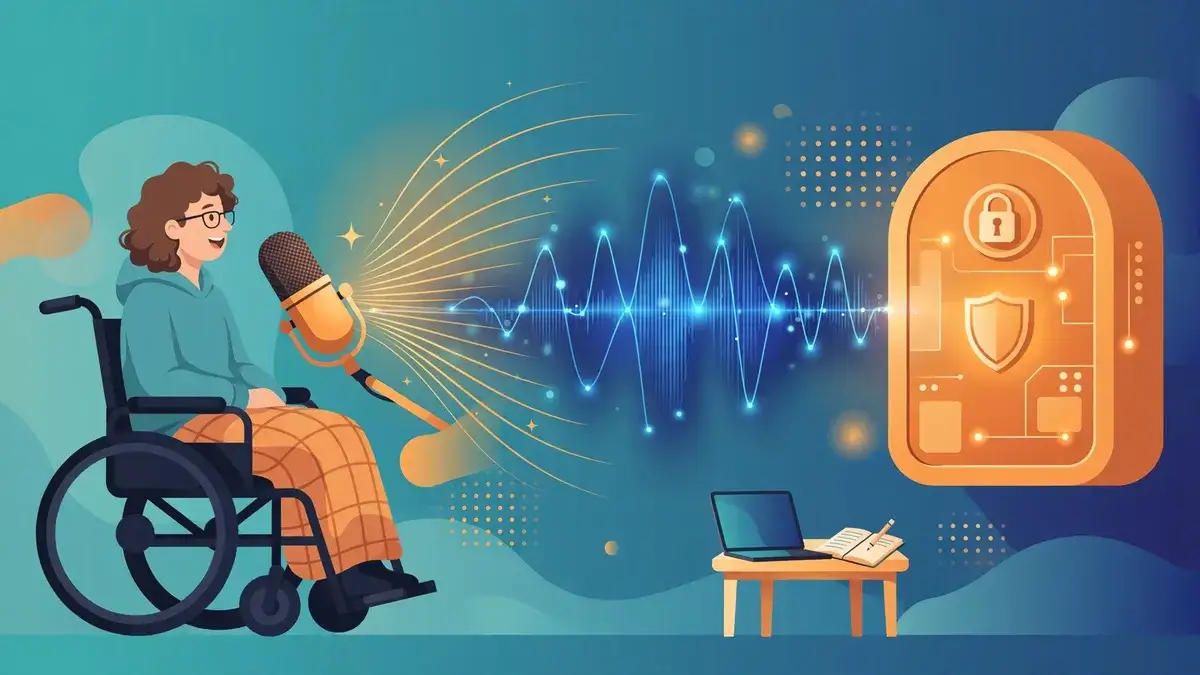
TL;DR: Voice banking lets people with MND record their own voice while they can still speak clearly, so a synthetic version of it can speak for them later. Starting early, recording about 1,600 short sentences in a quiet room, and choosing a reputable voice-banking service gives you the best chance of keeping a voice that still sounds like you.
Motor neurone disease (MND) — known as ALS, amyotrophic lateral sclerosis, in the United States — slowly takes away the muscles that make speech possible. For many people living with MND, losing their voice is one of the hardest parts of the disease — harder, some say, than losing the ability to walk. Voice banking fights back: you record your voice now, while it is still strong, and a computer model learns to speak in your voice later, when your own speech becomes difficult or impossible.
This guide explains what voice banking is, how it works, when to start, what it costs, and how to get a recording that sounds like you — not like a robot reading your words.
What Is Voice Banking?
Definition: Voice banking is the process of recording a large set of spoken sentences so that text-to-speech software can build a personalised synthetic voice that sounds like the speaker.
Unlike a generic text-to-speech voice, a banked voice is built from your own recordings. It captures your pitch, your rhythm, your accent, and the small quirks that make your voice recognisably yours. Once the model is trained, you type what you want to say and the software speaks it in your voice — on a phone, a tablet, or a dedicated speech-generating device.
Voice banking is not the same as recording a few voicemail greetings. A banked voice is trained on hundreds or even thousands of carefully chosen sentences, which is what lets it pronounce words you never recorded. The idea began in assistive technology for people with degenerative conditions, and it has become far more realistic as AI voice models have improved.
If you want the full background on the technology behind it, our voice banking guide explains the history and the different approaches in more depth.
Why Does Voice Banking Matter for MND Patients?
MND affects the motor neurons that control the muscles of the lips, tongue, jaw, and vocal cords. Speech usually changes gradually: first a slight slur or a voice that tires quickly, then words that are harder to understand, and eventually very limited speech. The timeline differs for everyone, but for most people with MND, speech is affected at some point.
Keeping your own voice matters for reasons that go beyond being understood. Your voice is part of your identity. Families say that hearing a loved one's real voice — even a synthetic version of it — makes communication feel personal instead of clinical. Children, partners, and friends recognise you in it. A generic computer voice can say the words, but it cannot say them as you.
There is also a practical side. A banked voice works with the communication apps and devices people with MND already use, from eye-gaze systems to simple tablet apps. Because the voice is yours, listeners understand it more easily — which matters enormously when every word takes effort to type.
Definition: Dysarthria is the medical term for the speech difficulty caused by MND — weak, slow, or slurred speech resulting from damage to the nerves that control the speech muscles.
How Does Voice Banking Work?
Banking your voice is simpler than most people expect. The whole process has five stages, and most of them can be done at home with equipment you may already own.
- Choose a service. Pick a voice-banking provider or app. Some are built specifically for MND and motor neurone disease; others are general AI voice platforms that support voice banking.
- Record your sentences. The service gives you a list of sentences to read aloud. You record them one at a time, usually through a phone or computer microphone, in a quiet room.
- Check your recordings. The app flags sentences that are too quiet, too noisy, or misread, and asks you to re-record them.
- Train the model. The service uses your recordings to build your synthetic voice. Training can take minutes with modern AI models, or up to a few days with older systems.
- Use your voice. You download the voice into a communication app or speech-generating device and type to speak in your own voice.
Do not try to finish all the recording in one sitting — your voice tires, and tired recordings make a worse model. Most services let you record a little each day and save your progress. Spreading the work over two to three weeks usually produces the best results.
When Should You Start Voice Banking?
As early as possible — ideally as soon as you receive an MND diagnosis, or as soon as speech changes are noticed. This is the single most important piece of advice in this guide, and every speech-language therapist who works with MND will say the same thing.
Voice banking only works with the voice you have today. A model trained on clear, strong speech will sound clear and strong. A model trained on speech that is already slurred or breathy will carry those problems forever, because the model learns exactly what it hears. Waiting until speech is noticeably affected means banking a voice that is already fading.
Starting early also protects you against the unpredictability of MND. Speech can change quickly, and a bad cold or a tiring week can temporarily make recording impossible. If your voice is already banked, none of that matters.
If your speech has already changed, do not give up. Record now, with the voice you have: a banked voice built from your current speech is still unmistakably yours, and far better than a generic voice. Record a little every day, and finish the sentence list before your speech changes further.
What Equipment Do You Need to Bank Your Voice?
You need a quiet room, a decent microphone, and a device that can run the banking app. Here is what works best:
| Equipment | What to use | What to avoid |
|---|---|---|
| Microphone | A USB condenser microphone, or a good headset mic | A laptop's built-in mic in a noisy room |
| Device | A smartphone, tablet, or computer running the banking app | An old phone with a crackling mic |
| Room | A small, carpeted room with curtains, doors and windows closed | A kitchen, bathroom, or any room with echo |
| Extras | A glass of water, printed sentence list, a comfortable chair | Recording when tired, ill, or after a long day of talking |
A headset microphone is a good middle ground: it keeps the distance from your mouth constant, which keeps the volume steady. If you use a phone, prop it on a stack of books about 15–20 centimetres from your mouth and do not hold it — handling noise ruins recordings.
Before you record a single sentence for real, do a test: record five sentences, play them back, and listen for background hum, echo, or clipping. If you can hear the fridge, the traffic, or the air conditioning, move rooms or record at a quieter time of day. Our guide on how to record a voice sample for AI voice cloning covers microphone placement, room setup, and the common mistakes that ruin a recording in detail.
How Much Speech Do You Need to Record?
It depends on the service: different technologies need different amounts of data. Modern AI models need far less than older systems, which is good news when your speech tires easily.
| Approach | Sentences needed | Recording time | Voice quality |
|---|---|---|---|
| Classic voice banking | 1,600 sentences | 3–5 hours total | Good, slightly robotic |
| Modern AI voice banking | 100–300 sentences | 30–60 minutes | Very natural |
| Short-sample AI cloning | 1–3 minutes of speech | Under 5 minutes | Natural, but less stable on unusual words |
| Message banking (single phrases) | 20–50 phrases | 10–15 minutes | Your real voice, but only for those exact phrases |
Most MND-focused services still recommend the full classic set of around 1,600 sentences, because it covers every sound combination in English and produces the most reliable voice. But if your speech is already tiring, a modern AI service that needs only 100–300 sentences is a sensible choice — a finished 300-sentence voice beats an unfinished 1,600-sentence one every time.
A useful middle path is message banking alongside full voice banking: record a few dozen phrases you say every day — "I love you", "good morning", "thank you", "I need help" — in your real voice. Those recordings can be played back exactly as you said them, which is perfect for the words that matter most, while the synthetic voice handles everything else.
Voice Banking vs. Voice Cloning: What's the Difference?
People use these terms interchangeably, but they describe different things, and the difference matters for MND.
| Feature | Voice banking | AI voice cloning |
|---|---|---|
| Purpose | Preserve your voice for future communication | Reproduce a voice from a short sample |
| Data needed | 100–1,600 sentences | As little as 1–3 minutes |
| Built for | People losing their speech | Creators, podcasters, businesses |
| Consent model | You bank your own voice | Must prove you own the voice |
| Typical cost | Often free for MND patients | Usually a paid subscription |
| Best for | Long-term daily communication | Content creation and narration |
Voice banking is a medical and assistive use case: you are preserving your own voice for yourself. AI voice cloning is the broader technology, and it powers everything from audiobooks to AI voice cloning for content creators. The two overlap — a banked voice is built with voice-cloning technology — but banking services add things cloning platforms do not, such as integration with speech-generating devices, support for eye-gaze typing, and pricing designed for patients rather than businesses.
One caution: because cloning technology is powerful, reputable services require proof that the voice is yours. That is a protection, not a hurdle. Read our guide to AI voice cloning consent laws in 2026 before using any general-purpose cloning platform, so you know what consent and documentation to expect.
What Happens to Your Banked Voice Later?
Once your voice is trained, it lives in the cloud or on your device, depending on the service. You connect it to a communication app — the software you type into — and from then on, everything you type is spoken in your voice. Most services let you use the voice on more than one device at once: your phone, tablet, and speech-generating device.
As MND progresses, your communication setup will change: you may move from typing on a keyboard to tapping on a screen, and later to eye-gaze control. Your banked voice works with all of these, because the voice itself is separate from the way you type. That is the point of banking it early — the voice stays the same while everything else adapts.
Ask your provider three questions before you commit: can you export your voice to another service, what happens to your recordings if the company closes, and who owns the voice model. A trustworthy provider will answer all three clearly. Your voice is yours; make sure the paperwork says so.
Definition: Message banking is recording specific phrases you use every day — greetings, jokes, names, and requests — so they can be played back in your real voice, word for word, whenever you need them.
How Much Does Voice Banking Cost?
Cost is the question most families ask, and the answer is encouraging: for people with MND, voice banking is often free. Several non-profit organisations and MND associations fund voice banking for patients, and some providers waive their fees entirely for people with an MND diagnosis. Your local MND association or your speech-language therapist can usually point you to the right programme.
Paid services typically charge a one-time fee or a monthly subscription, broadly in the range of a few tens to a few hundred dollars, depending on the provider and the features. Communication apps that use the voice may charge separately. Before paying anything, check whether your health insurance, national health service, or an MND charity will cover it — many do, but you usually have to ask.
The real cost is not money; it is time and energy. Recording 1,600 sentences takes hours of speaking, spread over days or weeks — a genuine effort when your speech is already tiring. That is why starting early matters: when your voice is strong, recording is easy. When it is not, every sentence costs you.
Getting Started Today
If you or someone you love has MND, here is the simplest possible plan. Talk to your speech-language therapist this week and tell them you want to bank your voice. Choose a service together, and record your first ten sentences today — just ten, in a quiet room, with your phone propped up on a stack of books. A start is what matters, because every sentence you record now is one your future self will be glad to have.
Your voice is the sound of you. Bank it while you still can.
Frequently Asked Questions
How long does voice banking take for MND patients?
With a classic service, expect 3–5 hours of recording spread over two to three weeks, at 15–30 minutes per session. Modern AI services need only 30–60 minutes in total. Training takes minutes to a few days, depending on the provider.
Can I bank my voice if my speech is already affected by MND?
Yes. Record now, with the voice you have today. A model trained on your current speech still sounds like you and is far better than a generic voice. Prioritise finishing the sentence list quickly, and record in short sessions so fatigue does not worsen the quality.
Is voice banking free for MND patients?
Often, yes. Several non-profit organisations, MND associations, and providers waive fees for people with an MND diagnosis. Check with your local MND association or speech-language therapist before paying for any service.
What is the difference between voice banking and message banking?
Voice banking trains a synthetic voice from hundreds of sentences, so it can say anything you type. Message banking records specific phrases — like "I love you" — in your real voice for playback. Most specialists recommend doing both.
Can my banked voice be used on any device?
Most banked voices work with the major communication apps and speech-generating devices, including eye-gaze systems. Ask your provider which apps support your voice before you commit, and confirm you can use it on more than one device.
Who owns my banked voice?
You should. Reputable providers state clearly that you own your voice model and your recordings, and that they will delete them if you ask. Avoid any service that claims ownership of your voice or refuses to explain what happens to your data.
What happens if I die before my voice is used?
Your banked voice remains available to your family according to the terms you agree with the provider. Some families use it to keep a loved one's voice in memorial recordings or messages. Decide in advance who should have access, and put it in writing.