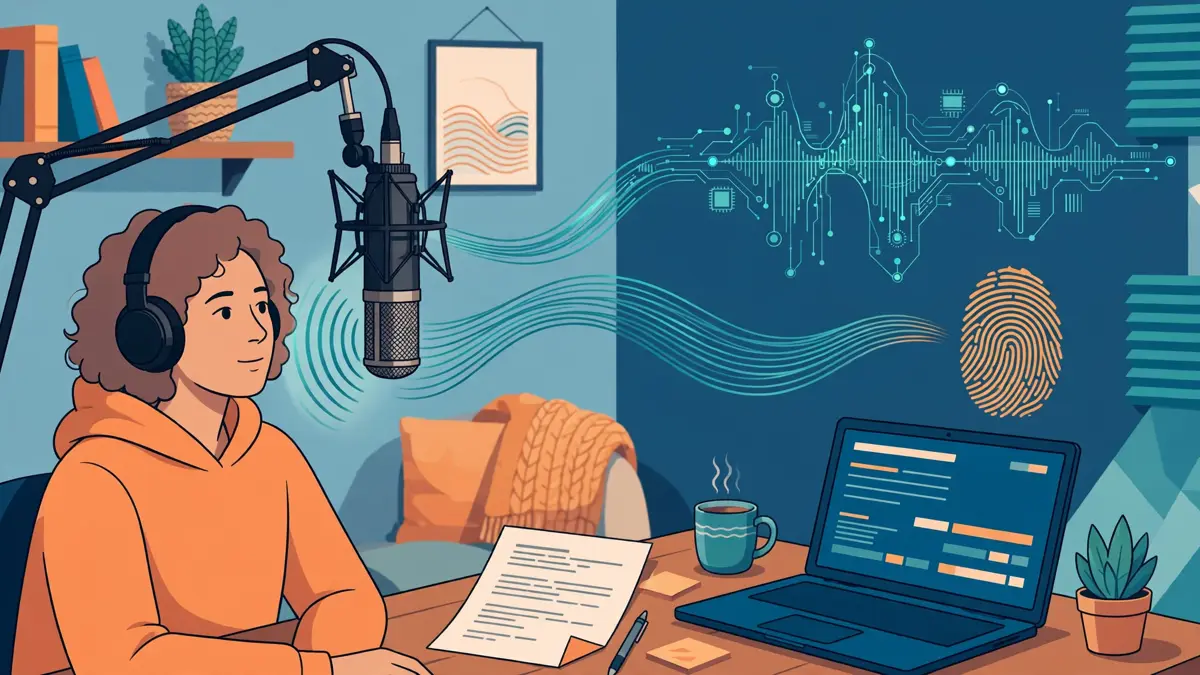
TL;DR: A good voice-cloning sample is 3–10 minutes of clean, natural speech recorded in a quiet room with a decent microphone. Read varied, expressive text at your normal pace, keep the mic 15–20 cm away, and record in one consistent session. The cleaner and more varied your sample, the more natural your AI voice will sound.
AI voice cloning can reproduce your voice from a surprisingly short recording — but only if that recording is good. A noisy, flat, or rushed sample gives the model bad raw material, and no software can invent detail that was never captured.
The good news: a quiet room, a reasonable microphone, and fifteen minutes of careful reading are enough. This guide covers exactly what to record, how to record it, and the mistakes that quietly ruin a clone.
If you are still deciding whether cloning is right for you, start with our guide to AI voice cloning for content creators — then come back here when you are ready to record.
What Makes a Good Voice Sample for AI Voice Cloning?
Definition: A voice sample is a recording of a single person speaking naturally, which an AI voice-cloning model analyses to learn the unique characteristics of that voice — its pitch, tone, rhythm, accent, and speaking style — so it can generate new speech that sounds like the same person.
The model learns from patterns, so it needs enough varied speech to find them. A sample that is too short, too monotone, or too noisy leaves gaps the model guesses at — and guesses are where clones sound wrong. Three qualities matter most:
- Clean audio. The model copies everything it hears — including your fridge hum, the traffic outside, and the echo off bare walls. Background noise does not just sit under the clone; it gets baked into the voice itself.
- Variety. Your voice changes with what you say: questions rise, statements fall, excitement speeds you up, and a story slows you down. A sample that covers many sounds, sentence shapes, and emotions gives the model a fuller picture of how you actually speak.
- Consistency. Record everything in one session, in one room, with one microphone, at one distance. If your voice sounds different in every clip, the model cannot tell which version is really you.
How Long Should Your Voice Sample Be?
Length depends on the tool, but the ranges below hold for most modern cloning services.
| Sample length | What you get | Best for |
|---|---|---|
| 30 seconds – 1 minute | A recognisable but rough clone | Quick tests and fun experiments |
| 3 – 5 minutes | A solid, usable clone for narration | YouTube voiceovers, podcast intros, short narration |
| 10 – 15 minutes | A high-quality clone with natural rhythm | Audiobooks, long-form narration, commercial work |
| 30+ minutes | The best possible fidelity | Professional voice work and voice banking |
Definition: Voice banking is the process of recording a large, carefully structured set of speech samples — often 30 minutes or more — so that a person's voice can be recreated later, most commonly by people who may lose their ability to speak. A voice-banking recording follows the same quality rules as a cloning sample, only with more material.
More is not always better. Ten minutes of clean, varied speech beats an hour of noisy, flat reading. If you only have time for one good session, aim for 5–10 minutes and make every sentence count. If you plan to use the clone professionally, record the longer set — you can always trim it down, but you cannot add quality that was never recorded.
What Equipment Do You Need to Record a Voice Sample?
You need less than you think. The microphone built into a modern phone can produce a usable sample in a quiet room, but a small upgrade makes a large difference — and it does not have to be expensive.
- A USB condenser microphone is the sweet spot for most people: models in the $50–$100 range record clean, detailed speech with no extra gear. Plug it in, set the level, and record.
- A headset microphone works if it sits close to your mouth and you speak at a steady volume, but it picks up more breathing noise and less of the warmth in your voice.
- Your phone is a genuine fallback: record in a quiet, carpeted room, hold it 15–20 cm away, and use an app that saves uncompressed WAV.
- Headphones are essential for monitoring — wear them while recording so you hear problems (a buzz, a fan, a neighbour's dog) before they ruin a take.
- A pop filter or a foam windscreen costs a few dollars and stops the explosive "p" and "b" sounds that create loud thumps in a recording.
What you do not need: a mixing desk, an audio interface, or acoustic foam on every wall. A decent USB mic in a quiet room beats expensive gear in a noisy one every time.
How Do You Set Up Your Recording Space?
Your room matters more than your microphone. A recording made in a tiled bathroom will sound hollow no matter how good the mic is, while the same mic in a bedroom full of soft furnishings will sound warm and close.
Pick the smallest, quietest, softest room you have — a bedroom with curtains, a carpet, and a wardrobe full of clothes is ideal. Close the windows and the door, switch off anything that hums (fans, air conditioning, the fridge if you can reach it), and put your phone on silent in another room.
Position yourself 15–20 cm from the microphone — about a handspan — and speak slightly across it rather than directly into it. This keeps breath noise down and gives your voice a natural, present sound. Do a 20-second test recording first: read a paragraph, play it back on headphones, and listen for echo, hiss, or background noise. Fix the room before you record the real thing.
Record in one sitting if you can. Your voice changes through the day — deeper in the morning, tighter when you are tired — and the model will notice. If you must split the session, record at the same time of day, in the same room, with the same setup.
What Should You Say in Your Voice Sample?
This is where most people go wrong: they read the same paragraph ten times, or they improvise and ramble. The model needs variety — different sounds, different sentence lengths, different emotions — so your script should be deliberately varied.
A good 5–10 minute script mixes these ingredients:
| Script ingredient | Why it matters | Example |
|---|---|---|
| Plain narration | Covers your everyday speaking voice | A news article or a page from a book |
| Questions | Teaches the model your rising intonation | "Have you ever wondered why the sky is blue?" |
| Exclamations | Captures energy and excitement | "That was incredible — I couldn't believe it!" |
| Numbers and dates | Forces varied pronunciation | "In 2024, over 3,500 people attended the event" |
| Names and places | Tests unusual sounds | "Maria Gonzalez flew from Guadalajara to Edinburgh" |
| Short dialogue | Adds natural pauses and rhythm | "Are you coming?" "Yes — give me five minutes." |
| Emotional lines | Shows range beyond neutral | A joyful memory, a serious warning, a gentle aside |
Write or collect about 800–1,200 words for a 5–10 minute sample (most people read 150 words per minute). Mix fiction, news, and conversation — the variety is the point. Avoid tongue twisters and poetry with unusual rhythm; the model needs your natural speech, not a performance. Read it as yourself: your normal pace, your normal energy, your normal accent. Trying to sound like a radio presenter is the fastest way to get a clone that sounds like someone else.
How Do You Record a Clean Voice Sample?
Once the room is set and the script is ready, follow these steps.
- Warm up your voice. Read the script aloud once, quietly, before you press record. Your first minute of speaking is always stiffer than your fifth — get it out of the way.
- Set your recording level. Speak at your normal volume and check the meter: your loudest words should peak around −12 dB, well below clipping. Too quiet and the model hears hiss; too loud and it hears distortion.
- Record in one continuous take if possible. Pauses are fine — the model ignores silence — but stopping and restarting changes your energy and your distance from the mic.
- Read at your natural pace. Do not rush. If you stumble, pause, go back to the start of the sentence, and carry on; you can edit the mistake out later, or just leave it — a small stumble does not hurt the model.
- Keep your distance steady. Do not lean in and out. If you move closer for a quiet line, the model hears a different voice; stay put and let your voice do the work.
- Record 10–20% more than you need. A few extra minutes give you room to cut the weakest takes and keep only the cleanest, most natural speech.
- Listen back before you upload. Play the whole sample on headphones. If you hear echo, hiss, or a neighbour's television, re-record — a flawed sample wastes the clone, not just the session.
Save the file as uncompressed WAV (44.1 kHz, 16-bit) if your tool allows it. MP3 is acceptable at a high bitrate, but every round of compression throws away detail the model could have used.
What Mistakes Ruin a Voice Clone?
Most bad clones trace back to a handful of avoidable errors — check your sample against this list before you upload it.
| Mistake | What goes wrong | How to avoid it |
|---|---|---|
| Recording in a noisy room | Noise gets baked into the clone's voice | Record in a quiet, soft room; test first |
| Speaking in a monotone | The clone sounds flat and robotic | Read varied text with natural emotion |
| Rushing through the script | Words blur together and the model mislearns sounds | Read at your normal, relaxed pace |
| Holding the mic too close | Popping "p" sounds and loud breaths | Stay 15–20 cm away; use a pop filter |
| Mixing sessions and microphones | The model cannot tell which voice is yours | One session, one room, one microphone |
| Using old, low-quality audio | Compression artefacts become part of the voice | Record fresh, in WAV, at 44.1 kHz |
| Cloning someone else's voice | Legal trouble and ethical problems | Only clone a voice you own or have permission for |
The last row matters more than the rest. Cloning a voice without the owner's clear consent is illegal in many places and unethical everywhere. If you are recording for someone else — a client, a colleague, a family member — get their written permission first. Our guide to AI voice cloning consent laws in 2026 explains what the rules actually require.
Is It Legal to Clone Your Own Voice?
Yes — cloning your own voice is legal, and it is the most common use of the technology. You own your voice, and you can use an AI version of it for your videos, podcasts, audiobooks, and business, just as you would use a recording of yourself.
The legal line is about other people's voices. Most jurisdictions now treat a person's voice as part of their identity: cloning a celebrity, a colleague, or a family member without their consent can break right-of-publicity, data-protection, and fraud laws, and several countries have passed specific AI-voice legislation in the last two years. Commercial platforms increasingly require proof of consent before they will clone a voice at all.
Keep it simple: clone your own voice, or a voice you have written permission to clone. If you are building a voice library for a business, get consent in writing before anyone records a sample. For the long-term side of preserving a voice, see our voice banking guide.
How Long Does It Take to Clone a Voice After Recording?
Once your sample is uploaded, the cloning itself is usually fast. Most services return a working clone within a few minutes to an hour, depending on the length of the sample and how busy the service is. Podcasters, for example, can start using theirs the same day — see our guide to AI voice cloning for podcast hosts.
What takes longer is testing. Before you use the clone for real work, generate a few test sentences — a long one, a question, a line with numbers — and listen carefully. If something sounds off, the problem is almost always the sample: check for noise, flat delivery, or inconsistent distance, and re-record the weakest section.
A good clone should survive the "friend test": play a sentence to someone who knows your voice and ask whose voice it is. If they answer without hesitating, you have a clone worth using.
Frequently Asked Questions
How long should a voice sample be for AI voice cloning?
Most tools need at least 30 seconds, but 3–10 minutes of clean, varied speech gives a noticeably better result. For professional work, 10–30 minutes is ideal. Quality matters more than length: five clean minutes beat an hour of noisy audio.
Can I record a voice sample on my phone?
Yes. A modern phone in a quiet, carpeted room can produce a usable sample. Hold the phone 15–20 cm from your mouth, use an app that saves uncompressed WAV audio, and record in one continuous session. A USB microphone will still sound better, but a phone sample is far better than no sample at all.
What should I read for my voice cloning sample?
Read varied, natural text: a mix of narration, questions, exclamations, numbers, names, and short dialogue. About 800–1,200 words covers 5–10 minutes of speech. Avoid monotone reading and tongue twisters — the model needs your normal voice, not a performance.
Do I need a professional studio to record a voice sample?
No. A small, quiet bedroom with curtains and soft furnishings works well, and a USB microphone in the $50–$100 range is enough. The room matters more than the gear: a good microphone in a noisy, echoing room will always sound worse than a phone in a quiet one.
How do I remove background noise from a voice sample?
The best fix is prevention: record in a quiet room with fans and appliances off. A noise-reduction tool can help an existing recording, but it can distort your voice — use it lightly. If the noise is loud or constant, re-record: it is faster and gives a better clone than cleaning a bad file.
Is it legal to clone someone else's voice?
Only with their clear, written consent. Many jurisdictions treat voice as part of a person's identity, and cloning without permission can break right-of-publicity, data-protection, and fraud laws. Always get written permission before recording or cloning another person's voice, even for a fun project.
Can I update my AI voice clone later with a better sample?
Yes. Most cloning services let you re-train or replace a voice model with a new, better sample at any time. If your first clone sounds flat or muffled, record a fresh sample using the tips in this guide and upload it — the improved clone usually replaces the old one without affecting your existing projects.