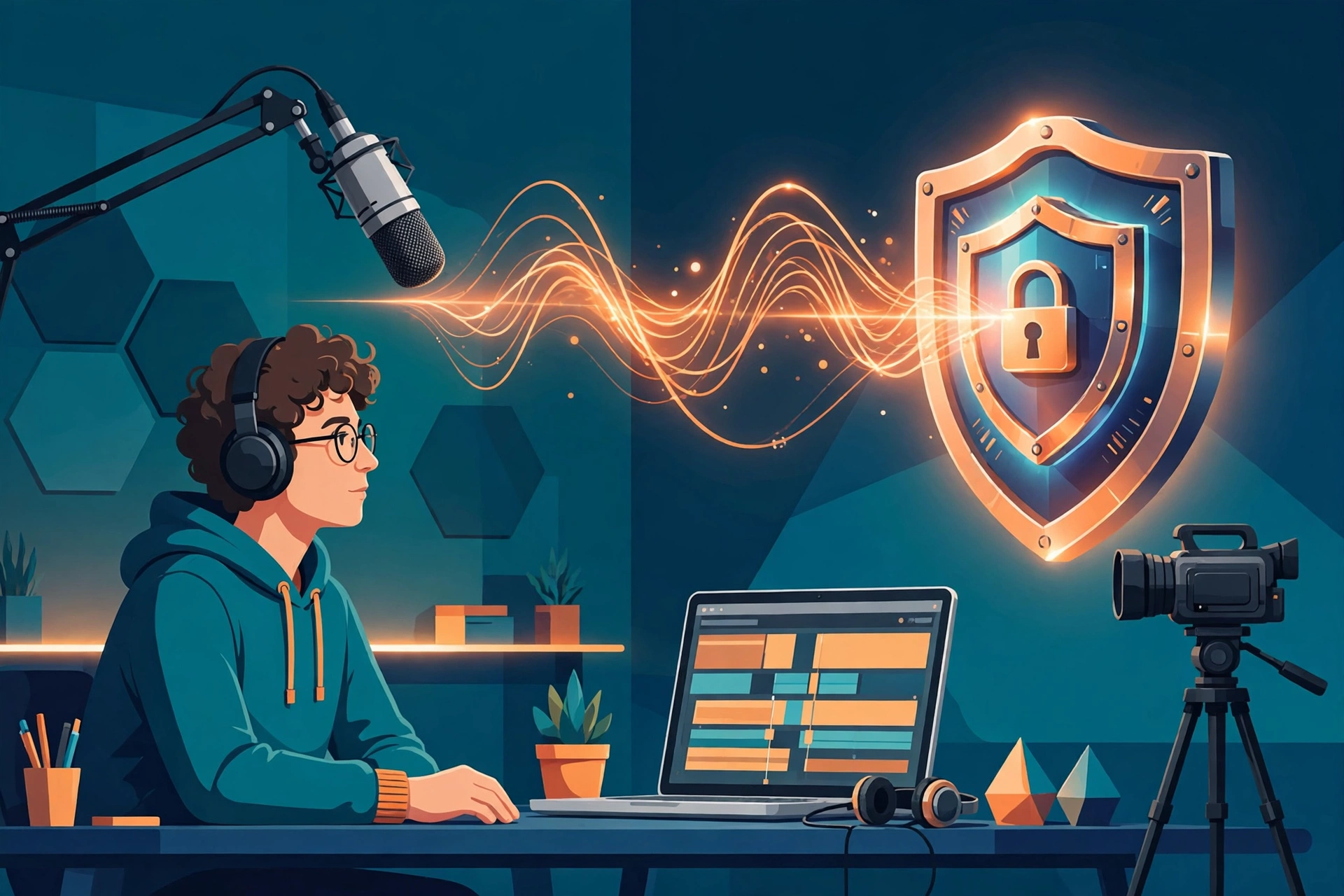
TL;DR: Voice banking for YouTubers means recording your voice now, while it is healthy, so a secure digital copy exists if illness, surgery, or vocal strain takes it away. It protects your channel's most recognizable asset and lets you keep publishing in your own sound. This guide explains how it works, what to record, and how to use it.
Your voice is your channel. Viewers recognize a YouTuber by their voice before they recognize the logo, the intro, or the thumbnail. It carries your jokes, your explanations, and your personality to your audience. Yet most creators protect everything about their channel except that one asset: they back up video files and project folders, and keep spare cameras — but they never back up the voice itself.
Voice banking changes that: record a set of your own voice samples now, while your voice is healthy, and store them securely so a synthetic version can be generated later if you ever need it. For YouTubers, whose income and audience depend on speaking on camera, that safety net is worth understanding before it is ever needed.
What Is Voice Banking for YouTubers?
Definition: Voice banking for YouTubers is recording a set of your own voice samples — read sentences, phrases, and natural speech — and storing them securely so a synthetic version of your voice can be created later if illness, surgery, or vocal strain makes speaking difficult or impossible.
The idea comes from medicine, where people facing conditions that affect speech have banked their voices for years. Creators are adopting the same practice because their voice is their livelihood: a YouTuber who loses their voice for a month loses momentum with the algorithm, income from ads and sponsors, and the trust of an audience that expects regular uploads.
A banked voice is not a replacement for you. It is an insurance policy: you record while healthy, the recordings are stored, and a synthetic version is only built from them if you ever need it. If you never need it, the recordings simply sit there, unused — the best possible outcome. To understand the recording process in detail, see how voice banking works.
Why Would a YouTuber Need to Bank Their Voice?
The most obvious reason is health. Vocal cord surgery, a serious throat infection, long-term strain, or a medical condition that affects speech can silence a creator temporarily — or permanently. A channel that depends on a single voice has a single point of failure.
The second reason is consistency. A channel's audience builds a relationship with a voice, and when a creator returns from a break with a hoarse or changed voice, viewers notice immediately. A banked voice lets a creator keep publishing in the sound their audience knows while their real voice recovers.
The third reason is workload. Many YouTubers record for hours a day, and vocal fatigue is a real occupational hazard. Having a banked voice does not mean you stop recording — it means you have an option for tired-voice days, for pickup lines, for corrections to an old video, or for a second-language version of a popular video. Podcasters face the same risk — see voice banking for podcasters for how audio-first creators approach it.
How Does Voice Banking Work?
Banking your voice is a recording project, not a technical one. You need a quiet room, a decent microphone, and about an hour of focused time.
- Choose a quiet recording space. A small room with soft furnishings works well. Turn off fans and anything that hums, and close the windows. Clean audio matters, because recording quality decides how natural the synthetic voice sounds later.
- Use a good microphone. A USB condenser microphone is enough. Record about a hand's width from the mic, and use a pop filter if you have one. Test a short sample and listen back on headphones before recording the full set.
- Record the prompt set. A voice banking service gives you a list of sentences to read aloud, designed to cover the sounds of your language. Read every sentence exactly as written, even if they feel strange or repetitive. That variety is the point.
- Record natural, conversational speech too. Record a few minutes of yourself talking naturally — telling a story or explaining something you know well. This captures your real speaking rhythm, your pauses, and your personality in a way scripted sentences cannot.
- Record in more than one tone. Read some material in your normal teaching voice, some in a more energetic style, and some in a calm, slower style. If your channel uses different tones, capture each one.
- Check the recordings and store them securely. Listen to every file before submitting it. Remove any recording with background noise, a cough, or a misread sentence, and re-record it. Then store the originals somewhere safe, with a backup copy separate, before you upload anything.
The whole process usually takes one focused session of an hour or two, plus review time.
How Is Voice Banking Different from Voice Cloning?
The two terms are often used as if they mean the same thing, but they describe different intentions.
Definition: Voice banking is recording your own voice samples in advance to create a synthetic version you can use later if you lose your ability to speak. Voice cloning is the broader technology of creating a synthetic copy of any voice from recordings; it can be used for your own voice, but it can also be misused to copy someone else's voice without their permission.
| Voice banking | Voice cloning | |
|---|---|---|
| Whose voice | Your own, recorded by you | Any voice, if recordings exist |
| When it is done | In advance, while your voice is healthy | Any time recordings are available |
| Purpose | A personal safety net for your own voice | Creating a synthetic copy for many uses |
| Consent | You record and control your own samples | Must have the voice owner's clear permission |
| Control | You decide if and when the voice is used | Depends on who controls the recordings |
For a YouTuber, voice banking is the safer frame: you are recording your own voice, for your own channel, under your own control. The same technology can also clone voices, which is why consent and security matter so much — and why you should only bank your voice with a service you trust and whose terms you have actually read. For a deeper look, read voice banking security.
What Should You Record for a Good Voice Bank?
The quality of a banked voice depends on the quality and variety of the recordings — a good voice bank covers the full range of sounds and styles you use on your channel.
| Recording type | What to include | Why it matters |
|---|---|---|
| Scripted sentences | The full prompt set, read exactly as written | Covers every sound in your language |
| Natural conversation | 5–10 minutes of unscripted talking | Captures your real rhythm and pauses |
| Channel-style narration | A script in your usual video tone | Matches the voice your audience knows |
| Energetic delivery | An intro or announcement in your excited style | Preserves your high-energy voice |
| Calm delivery | A slow, relaxed explanation | Gives you a quieter option for later |
| Numbers and names | Dates, prices, names you say often | Prevents mispronunciation of familiar words |
Record at the time of day you normally record videos, when your voice is warmed up the way your audience hears it. Drink water before and during the session, and take short breaks — a tired voice at the end of a long session sounds different from your normal voice. If you make a mistake, pause and re-read the sentence.
Do not record with a cold, a sore throat, or any illness that changes your voice — the banked voice will preserve whatever you record, including the cold. Wait until you are fully healthy.
How Much Does Voice Banking Cost for a YouTuber?
There is no single price for voice banking — it depends on what you want the banked voice to do. Some options are free, some are part of a voice tool subscription, and some are dedicated services with their own pricing.
| Option | Typical cost | What you get |
|---|---|---|
| Basic voice banking in a voice tool | Included in a subscription or a low one-time fee | Your voice stored and ready to use |
| Dedicated voice banking service | Varies; often a one-time setup fee | Guided recording, secure storage, support |
| Recording equipment | A decent USB microphone costs less than a camera lens | Clean audio that makes a better banked voice |
| Ongoing use | Usually charged by the amount of audio you generate | Pay only when you actually use the banked voice |
Two things are worth remembering. First, the recording itself costs almost nothing if you already own a microphone — the value is in the time you spend recording carefully. Second, compare prices before you commit: some services charge for storage, some for generation, and some for both. Never choose on price alone — a cheap service without clear security and deletion policies is a bad deal at any price.
How Can YouTubers Use a Banked Voice on Their Channel?
A banked voice is most useful for the jobs that are hard to do with a sore throat but easy to do with a script — the ones your audience will never notice, because the audio sounds like you on a normal day.
Fixing mistakes in old videos. Every creator has a video with one wrong word or mispronounced name. Re-recording one sentence with your banked voice and editing it in fixes the error without re-shooting the whole video.
Publishing while you recover. If illness or vocal strain keeps you from recording, a banked voice lets you publish a scripted video — a commentary, an explainer, a list video — in your own voice while your real voice rests. Tell your audience honestly; viewers respect that transparency.
Creating versions in other languages. A popular video can reach a much larger audience in another language, but re-recording it by hand takes hours. A banked voice can generate the same script in another language in your own sound.
Recording pickups and shorts. Short-form videos, channel updates, and sponsored reads are often recorded in a rush. A banked voice can generate them quickly from a script, in a consistent tone, without another session.
Keeping a series consistent. If your channel runs a series with a signature narration style, a banked voice keeps every episode sounding the same, even when recorded weeks apart. See voice banking for content creators for the broader picture.
One rule applies to all of these uses: always label clearly when a video's narration was generated from your banked voice rather than recorded live. Your audience trusts your voice — honesty about when it is banked keeps that trust intact.
What Are the Risks of Voice Banking, and How Do You Stay Safe?
A banked voice is a copy of something deeply personal, so the risks are real — but all of them can be managed with a few habits.
Unauthorized use is the biggest risk. A synthetic copy of your voice could be used to say things you never said. Bank only with services that require your login and approval before generating audio, keep your recordings private by default, and let you delete your voice data completely. If a service claims broad rights to use your voice, do not use it.
Definition: Consent in voice banking means your clear, written permission for a specific use of your voice — and permission for one use is not permission for every use.
Leaks and breaches are the second risk. Voice recordings are data, and data can leak. Keep your backup copies in a secure place, use a strong, unique password, turn on two-factor authentication, and do not share your voice files with anyone who does not need them.
Misleading your audience is the third risk. Using a banked voice without telling anyone can damage trust if viewers discover it later. Be open about it: a short note in the video description — "narration generated from my banked voice while I recover" — is enough.
Finally, a banked voice is a tool for your own channel, not a way to speak for other people. Never use it to imitate another creator, a public figure, or anyone else.
Starting takes less time than editing one video. Pick a day this week when your voice feels normal, block out two quiet hours, and record the prompt set, a few minutes of natural conversation, and a sample in each tone your channel uses. Listen to every file, store the originals safely with a backup copy, then upload them to a service whose terms you have read and that lets you delete your voice data. Test the banked voice while you are still healthy. Your voice has carried your channel this far; banking it is a one-time job that protects everything it has built.
Frequently Asked Questions
What is voice banking for YouTubers?
Voice banking for YouTubers is recording your own voice samples now, while your voice is healthy, and storing them securely so a synthetic version can be created later if illness, surgery, or vocal strain makes speaking difficult.
How long does it take to bank your voice?
Most creators finish in one focused session of one to two hours, plus time to listen back and re-record weak takes. Setup takes a few minutes if you already own a microphone.
Does voice banking sound like my real voice?
A well-recorded voice bank sounds very close to your real voice, especially for scripted narration in your normal tone. Record carefully and test a sample before you rely on it.
Is voice banking the same as voice cloning?
No. Voice banking means recording your own voice in advance as a personal safety net. Voice cloning is the broader technology of creating a synthetic copy of a voice, which can also be used on other people's voices — that is why consent and security rules matter.
Can I use my banked voice to keep uploading while I am ill?
Yes. A banked voice can generate scripted narration — commentaries, explainers, list videos — in your own sound while your real voice recovers. Tell your audience honestly; viewers respect that transparency.
What equipment do I need to bank my voice?
A quiet room and a decent USB condenser microphone are enough. Record at a comfortable distance from the mic, use a pop filter, and listen back on headphones before submitting your recordings.
How do I keep my banked voice secure?
Bank only with a service that keeps your recordings private by default, requires your login and approval before generating audio, and lets you delete your voice data completely. Use a strong, unique password and turn on two-factor authentication.