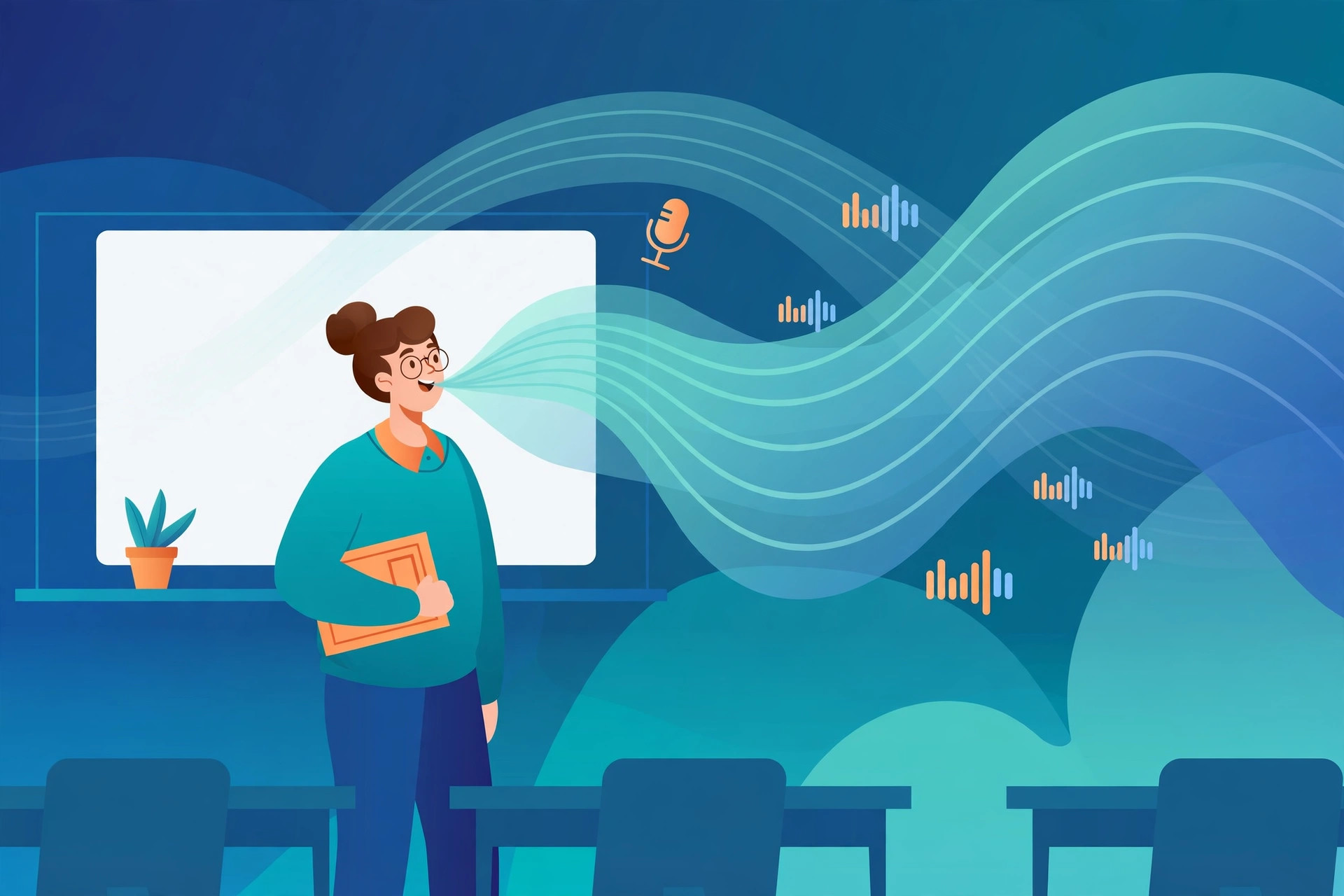
TL;DR: Voice banking lets teachers record their voice now so a synthetic version exists if illness or injury ever takes their speaking voice away. This guide explains who it helps, how recording sessions work, how much speech to bank, what it costs, and how teachers can use a banked voice for lessons, narration, and accessibility.
A teacher's voice is a working tool: it explains fractions at 9 a.m., settles a noisy classroom after lunch, and reads stories aloud. Most teachers speak for hours every working day, often louder than they should, in rooms never designed for the human voice. That workload takes a toll — hoarseness that never clears, vocal nodules, or a condition that makes speaking painful for weeks. Voice banking is a practical answer: record your voice while it is still healthy, so a synthetic version exists if you ever need it.
What Is Voice Banking?
Definition: Voice banking is recording a set of spoken sentences in your own voice so that a personal synthetic voice can be created from those recordings and used later if your natural voice is lost or weakened.
Think of it as a voice savings account: you deposit recordings now, while your voice is strong, and withdraw a usable voice later only if you need it. The recordings train a voice model — a digital copy of the sound, rhythm, and character of the way you speak. When you type text, the model reads it aloud in a voice that sounds like you.
Unlike a simple recording, a banked voice can say anything you type, not only the sentences you recorded — which is what makes it useful for teaching. If you are new to the idea, start with our plain-language introduction, What Is Voice Banking? A Beginner's Guide.
Why Are Teachers at Higher Risk of Losing Their Voice?
Teaching is one of the most voice-intensive jobs there is. A typical teacher speaks for several hours a day, projecting across a classroom of thirty or more students and competing with background noise, five days a week for most of the year.
Definition: Vocal load is the total amount and intensity of speaking a person does over a day or a week. Teachers carry one of the highest vocal loads of any profession, because their work is almost entirely spoken.
The strain shows up in familiar ways: a voice hoarse by Friday and recovered by Monday is an early warning sign. Pushing through hoarseness, speaking over noise, or teaching while fighting a cold adds to the strain. Over months and years, that pattern can lead to vocal nodules, polyps, chronic laryngitis, or muscle tension dysphonia — conditions that make speaking painful and can require weeks of voice rest or surgery.
There are also risks nobody can plan around: a sudden illness, a neurological condition, throat surgery, or an accident can take a teacher's voice away with little warning. People living with conditions such as ALS know this risk well — our guide to voice banking for people with ALS explains why banking early matters most when a diagnosis changes the timeline. Your voice is your livelihood, and the best time to protect it is while it is still healthy.
Who Should Consider Banking Their Voice?
Not every teacher needs a banked voice, but some have more reason than others. The table below covers the groups who benefit most.
| Teacher group | Why voice banking helps |
|---|---|
| Classroom teachers (primary and secondary) | Hours of daily projected speaking; highest risk of voice strain |
| Lecturers and university tutors | Long lectures in large halls; a banked voice can narrate recordings |
| Language and drama teachers | Voice is the subject itself; accent, tone, and expression matter |
| Teachers with a diagnosed voice condition | A banked voice is a safety net before the condition progresses |
If you have already noticed recurring hoarseness, a voice that tires by midday, or a doctor's warning about your vocal cords, you are a strong candidate. And age matters in the opposite way from what people expect: a young teacher has decades of speaking ahead — decades of vocal load. Banking early, while the voice is at its strongest, produces the best recordings.
How Does Voice Banking Work for Teachers?
The process is straightforward and fits around a teaching schedule — most teachers finish in a few short sessions spread over a week or two.
- Choose a quiet room — a small, carpeted room with soft furnishings works well. Close windows, switch off fans and air conditioning, and pick a time when the school is quiet.
- Use a decent microphone — a USB headset or simple USB condenser microphone is enough. Keep it the same distance from your mouth for every session.
- Record the scripted sentences the tool gives you, chosen to cover the full range of sounds in your language. Read them naturally, at your normal teaching pace.
- Record in short sessions of twenty to thirty minutes. Your voice changes as it tires, so short sessions keep the recordings consistent. Take breaks, drink water, and stop if your voice feels strained.
- Review and re-record the weak lines. If a sentence was mumbled, rushed, or interrupted by a noise, record it again — a few clean takes matter more than many sloppy ones.
- Your voice model is built from the recordings. Type any text and hear it read aloud in your voice.
For a fuller walkthrough, see How Voice Banking Works. One tip: also record the sentences you actually say in class — "Take out your notebooks," "Who can tell me the answer?" — because those are the lines your banked voice will say most often.
How Much Speech Do You Need to Bank?
The honest answer is that it depends on the tool and on the quality you want. More recordings usually mean a more natural-sounding voice, but there is a point where extra recording brings little improvement.
Thirty to sixty minutes gives you a usable voice for short announcements and simple narration. One to two hours — the sweet spot for most teachers — produces a natural-sounding voice for lessons, stories, and longer narration. Three or more hours gives the most expressive voice. Record in your normal teaching voice, at your usual classroom pace. Quality beats quantity: ten minutes of clear recordings in a quiet room are worth more than an hour recorded next to a humming projector, and a congested voice trains a congested model — so avoid recording with a cold.
How Can Teachers Use a Banked Voice in the Classroom?
A banked voice is only useful if it fits real teaching — and teachers have more uses for one than almost any other profession, because so much of teaching is spoken explanation.
The most immediate use is recorded lessons. If you are ill, on voice rest, or away from school, a banked voice can narrate the lesson you would otherwise have delivered live. Students hear your voice — your pace, your emphasis, your familiar way of explaining — rather than a stranger's. Recorded lessons also help absent students, or those who need to hear an explanation a second time.
A banked voice also works for accessibility: students with hearing difficulties, students learning in a second language, or students who process spoken instructions better than written ones all benefit from clear, consistent narration. A teacher can generate audio versions of worksheets, instructions, and revision notes in their own voice.
Classroom narration is another everyday use: morning announcements, story reading, audio instructions for group work, and feedback on student work can all be generated in your voice. This matters most on the days your real voice is tired — instead of pushing through hoarseness, your banked voice can carry the parts of the lesson that do not need live interaction. Teachers who also create content outside the classroom will recognise the same pattern — our guide to voice banking for content creators shows how creators use a banked voice for videos and audio, and our guide to voice banking for seniors and accessibility covers the same benefits in a different setting.
What Does Voice Banking Cost?
Cost is the question most teachers ask second, right after "does it actually sound like me?" The answer varies: the price depends on how much you record, how the voice is used, and whether you need ongoing access.
Some tools offer a free tier or a one-time setup with limits on monthly audio. Others charge a monthly subscription, usually scaled to the amount of speech you generate. A teacher who needs only a few minutes of narration a week will pay far less than a creator who generates hours of audio every day.
Some services aimed at people with medical needs offer reduced or no-cost voice banking for people with a diagnosed condition that threatens their speech — if you have a diagnosis, ask whether you qualify, and ask your school or local health service whether any support is available. Before paying anything, check what is included: the recording minutes, the generated audio per month, how long your recordings and voice model are stored, and whether you can download or export your audio. A teacher who banks one to two hours of recordings and generates a modest amount of lesson audio each month should expect the cost to sit at the low end of the subscription range for voice tools — comparable to a single classroom resource subscription, not a major purchase.
How Is a Banked Voice Stored and Protected?
Your voice recordings are personal — they contain your voiceprint, the unique characteristics of how you sound — so before you bank your voice, understand where the recordings live and who can use them.
Definition: Informed consent means giving clear, specific permission for exactly how your voice recordings and voice model may be used, and understanding that permission before you agree to it.
Ask before you record: Where are the recordings stored, and for how long? Who has access to them? Can anyone else use your voice model? Can you delete your recordings and voice model? A trustworthy service answers all of these clearly, in plain language, and lets you delete your data.
Consent matters even more for teachers, because your voice is also heard by your students. Never use a banked voice to imitate a colleague, a student, or anyone else — only your own voice. Our guide to voice cloning consent and ethics explains the consent rules, and our voice banking security guide covers how to keep your recordings and voice model safe.
Practical steps help too: use a strong, unique password for the account that holds your voice model, turn on two-factor authentication if it is available, and do not share your login with colleagues. Keep a backup of your original recordings in a safe place of your own, so you are not locked into a single tool.
What Are the Limits of a Banked Voice?
A banked voice is a powerful safety net, but it is not a perfect copy of you, and teachers should know its limits before relying on it.
First, a synthetic voice cannot replace live teaching. It cannot read a room, notice a confused face, or respond to a student's question. It is best for prepared material — recorded lessons, instructions, narration — and weakest for the spontaneous, interactive parts of teaching.
Second, emotion and expression have limits. A banked voice can sound warm, clear, and natural on straightforward text, but it may struggle with humour, sarcasm, or excitement. Short sentences and simple language sound best.
Third, a banked voice is only as good as its recordings. If you banked your voice on a tired day, or in a noisy room, those flaws carry into the model. And a banked voice is a snapshot of your voice at the time you recorded it — if your natural voice changes over the years, the model will not change with it.
Frequently Asked Questions
What is voice banking for teachers?
Recording your voice while it is healthy, so a personal synthetic voice can be created from it. If illness, injury, or a voice condition later affects your speaking voice, the banked voice can narrate lessons and read instructions for you.
How long does it take a teacher to bank their voice?
One to two hours of recorded speech, in short sessions of twenty to thirty minutes. Spread over a week or two, the whole process takes a few hours.
Does a banked voice really sound like me?
A good banked voice sounds recognisably like you — your pitch, pace, and way of speaking. It is not a perfect copy, and it handles straightforward narration better than humour or high emotion, but students will recognise it.
Can I use my banked voice if I am on voice rest?
Yes, that is one of the best uses for it. While your real voice recovers, your banked voice can narrate recorded lessons and read instructions aloud, so you can keep working without straining it.
Is voice banking only for teachers with a voice condition?
No. Teachers with a diagnosed condition have the strongest reason to bank early, but any teacher whose job depends on hours of daily speaking can benefit. Banking while your voice is healthy gives the best recordings.
Who owns my banked voice and my recordings?
You should. Check that the service gives you full ownership and control of your recordings and voice model, including the right to delete them. Never bank someone else's voice without consent.
Can my school use my banked voice without my permission?
No — not without your informed consent. If your school wants to use it, that should be agreed in writing, with clear limits on its use and duration.
How do I keep my banked voice safe?
Use a strong, unique password and two-factor authentication on the account that holds your voice model. Keep a backup of your recordings, only record your own voice, and check the privacy terms — especially storage length and deletion.
Conclusion
Your voice is the tool you use most in teaching, and the one most teachers take for granted until it falters. Voice banking is a small investment of time — a few short recording sessions while your voice is strong — that protects decades of teaching. It does not replace live teaching, and it will not make a tired voice healthy again. What it does is give you a backup: a voice that sounds like you, ready to narrate a lesson, read a story, or guide a class on the days your own voice needs a rest. If you teach for a living, your voice is worth protecting — record it now.