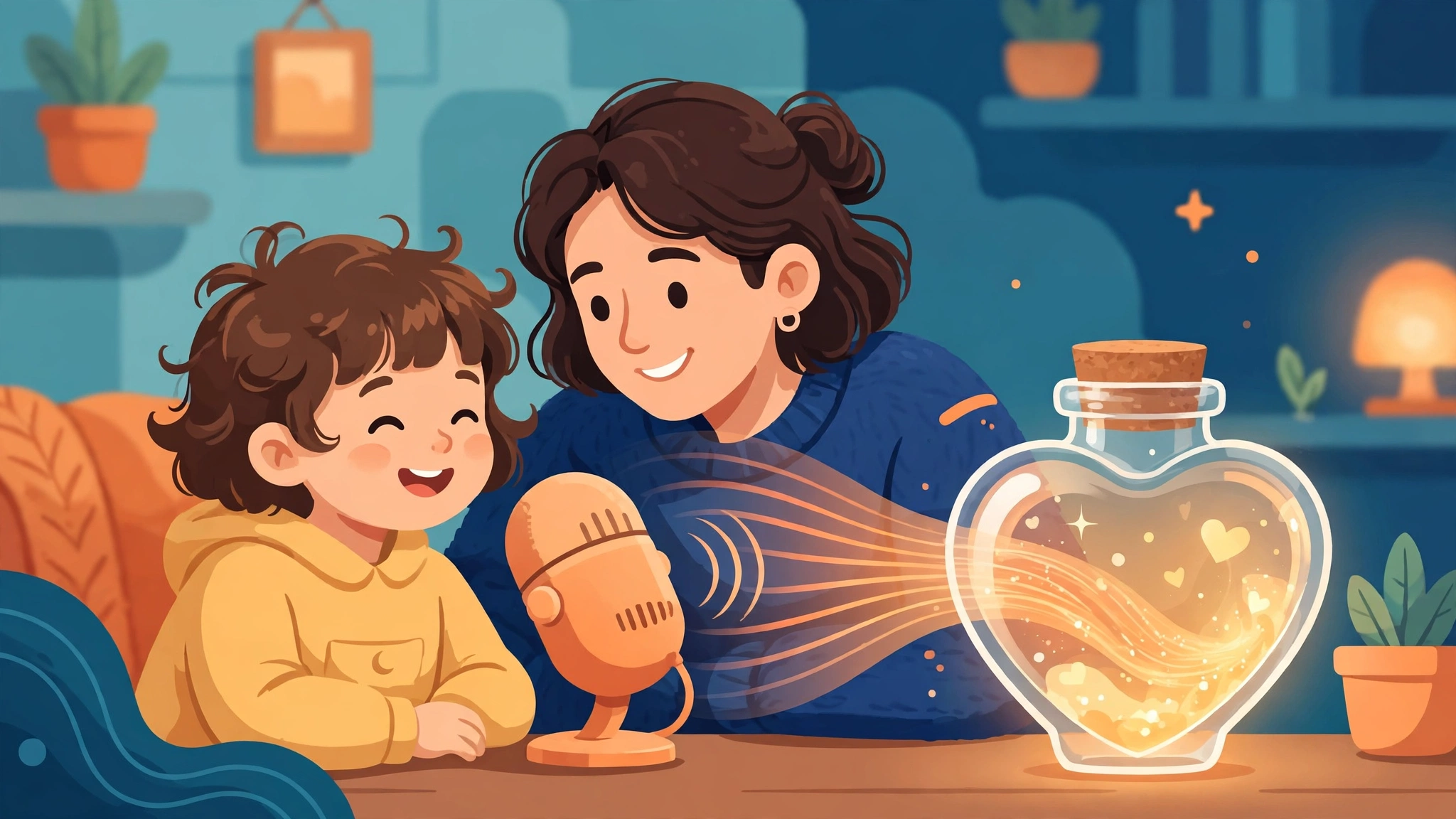
TL;DR: Voice banking for children means recording your child's voice now so a synthetic version can speak for them later if illness, surgery, or a condition ever takes their natural speech away. A parent gives consent, the child reads short phrases into a phone, and the recordings build a personal voice model for a communication app.
What Is Voice Banking for Children?
Every parent knows the sound of their child's voice — the way they say goodnight, the laugh after a joke, the exact tone of "Mum, watch this." Voice banking for children protects that sound, by recording it now so it can still speak for your child in the future.
Definition: Voice banking is the process of recording a set of spoken phrases to create a personalised synthetic voice — a digital copy of a person's own voice that can speak on their behalf if they ever lose the ability to speak.
For adults, voice banking is usually planned around a diagnosis or an operation. For children, the reasons are similar, but the decisions sit with parents, and the recordings must fit a child's patience, attention span, and changing voice. If you are considering it for your own child, start with our general guide to what voice banking is.
Why Would a Child Need Their Voice Banked?
Children lose speech for many of the same reasons adults do, but a child's voice is still developing and the conditions that threaten it often arrive early. Parents usually explore voice banking for one of these reasons:
| Reason | What it means for your child | When to act |
|---|---|---|
| A progressive condition | Conditions such as spinal muscular atrophy, Duchenne muscular dystrophy, or a degenerative neurological disorder can gradually weaken speech | As soon as a diagnosis is confirmed, while the voice is still strong |
| Planned surgery | Surgery on the throat, larynx, jaw, or brain can change or remove the voice | In the weeks before the operation |
| A brain injury or stroke | A serious injury can damage the parts of the brain that control speech | Once your child is stable enough to record, even in short sessions |
| A speech or communication disorder | Some children are expected to lose intelligible speech as they grow, even if they can speak clearly now | Early, before speech becomes harder to understand |
| A family legacy | Parents record a healthy child's voice so it is preserved for the future | Any time — there is no medical deadline |
Timing matters most. A voice banked while it is clear and strong sounds far better than one recorded after speech has weakened. If your child's doctor or speech and language therapist has mentioned future speech loss, that is the signal to start — not a reason to wait.
At What Age Can a Child Bank Their Voice?
There is no single minimum age — the real requirement is the ability to read or repeat phrases clearly for a short session. In practice, most services work best with children aged around six and older, when reading is established and a child can sit through a session without becoming distressed.
Younger children can still be recorded, but the process looks different. A four- or five-year-old may repeat short phrases after a parent instead of reading them, in sessions of five minutes spread over many days. The recordings will be less consistent, but for a child facing surgery soon, even a partial voice is far better than none.
A child's age also affects what the banked voice can do later. Children's voices change dramatically as they grow — pitch drops, pronunciation sharpens, and vocabulary expands. A voice banked at age seven will still sound like a seven-year-old when your child is twelve — the banked voice is a snapshot of your child at the age they recorded it.
Talk to your child's speech and language therapist about timing — they can judge whether the speech is clear enough to bank, and whether waiting would risk losing the voice altogether.
How Does Voice Banking Work for a Child?
The process matches adult voice banking in outline, but every step is adapted for a young speaker. Our guide to how voice banking works covers the full process; here is the child-sized version.
Definition: A voice model is the digital file a voice-banking service creates from a child's recordings. It stores the patterns of their speech — pitch, tone, rhythm, and pronunciation — so any text can be spoken in a voice that sounds like them.
Here is how it usually goes:
- Choose a service together. Look for a service that works with children, explains consent clearly, and lets you keep a copy of the recordings.
- Record in short, happy sessions. Your child reads or repeats phrases into a phone microphone, in a quiet room, for five to fifteen minutes at a time.
- Upload the recordings. The audio is sent securely to the service for a quality check.
- Build the voice model. The system trains a personal voice model from the recordings. This usually takes a few hours to a couple of days.
- Test it together. You type a sentence your child loves — a joke, a favourite line from a book — and listen to their banked voice say it.
- Connect it to a communication app. The voice is paired with an app on a tablet or phone, so your child can type what they want to say and hear it in their own voice.
Older voice-banking systems needed around 1,500 sentences to build a usable voice — an impossible ask for a child. Modern AI voice models need far less: some services now produce a convincing voice from as little as a few minutes of clean audio.
How Do You Record a Child's Voice for Banking?
Recording a child is different from recording an adult: children need the session to feel like a game, not a test. The quality of the banked voice depends on the recordings, so a little preparation goes a long way.
| Session tip | Why it matters | How to do it |
|---|---|---|
| Keep sessions short | A tired child's voice changes — it gets flat, quiet, or sloppy | Five to fifteen minutes, then stop, even if they want to continue |
| Record when they are fresh | Morning recordings sound brighter and clearer than evening ones | Pick the time of day your child is most chatty |
| Use a quiet room | Background noise becomes part of the voice model | Turn off the TV, close windows, and record in a room with soft furnishings |
| Make it playful | A relaxed child speaks naturally; a nervous child rushes | Let them read favourite lines, jokes, and storybook sentences |
| Keep the microphone steady | Varying distance changes the sound of every phrase | A phone on a small stand, about 15–20 cm from their mouth, works well |
| Repeat unclear phrases | One mumbled phrase can weaken the whole model | Re-record any phrase that was giggled through, whispered, or cut off |
Record in the same room and position each time, so the sound stays consistent. Avoid recording with a cold, and keep phrases varied — questions, exclamations, ordinary sentences — so the system hears every sound in the language.
Let your child stop whenever they want — a forced session produces poor recordings. If they are not in the mood, try again tomorrow.
What About Consent, Privacy and Safety?
A child's voice is sensitive personal information, and banking it creates a permanent digital copy. The rules are stricter than for adults, and any service you use should answer these questions clearly.
First, consent. A child cannot legally consent to voice banking, so a parent or legal guardian must give informed consent on their behalf. Good services explain in plain language what is recorded, where it is stored, who can access it, and how it can be deleted. As your child grows older, involve them in the decision in an age-appropriate way — a child who understands why they are recording cooperates far better than one who feels something is being done to them.
Second, privacy. Your child's recordings are biometric data — they identify your child as surely as a fingerprint. Reputable services store them encrypted, limit access, and explain their retention policy. Before you start, ask where recordings are stored, who can listen to them, and whether you can delete everything permanently. If a service cannot answer, do not use it. Our guide to voice banking security explains the checks that matter for any user, and they matter twice as much for a child.
Third, misuse. A banked voice could, in theory, be used to say things your child never said. That is why ownership matters: you, as the parent, should own the voice model or hold the right to control where it is used. Never share your child's banked voice publicly or use it in advertising, and guard the service login like a password to your child's medical records.
How Much Does Voice Banking for Children Cost?
Voice banking for children is frequently free, because the medical reasons behind it are usually covered by someone else.
| Option | Typical cost | Best for |
|---|---|---|
| Charity-funded programmes | Free | Children with a diagnosed condition — charities often cover the full cost |
| Health service provision | Free | Families whose hospital or speech therapy service provides voice banking |
| Consumer voice-banking apps | Free – $100 one-off | Families recording for legacy or personal reasons |
| Professional voice cloning services | $20 – $100 per month | Ongoing use, audiobooks, or content creation |
If your child has a diagnosis, ask your speech and language therapist or hospital team first — charities often fund the full cost, and the recommended service will suit the communication device your child is likely to use.
Without a medical reason, the cost is modest — a one-off app purchase or short subscription is usually enough. Be wary of services that charge a large fee but will not let you download the voice model or recordings: a cheap service that locks your child's voice inside its own app is worse than one that lets you take it anywhere.
How Is a Child's Banked Voice Used Day to Day?
Once the voice model is ready, it usually lives inside an AAC app — augmentative and alternative communication software — on a tablet or a dedicated communication device.
Definition: AAC (augmentative and alternative communication) is the name for the tools and apps that help people communicate when speech is difficult or impossible — from picture boards to tablet apps that speak typed words aloud.
In practice, the school day is where a banked voice earns its keep. Your child types or taps a message — "Can I play too?", "I need help, please" — and the device speaks it in their own voice, not a generic robotic one. Classmates respond to a familiar voice far more warmly than to a machine voice, and children who sound like themselves join in more often.
At home, the same voice reads bedtime stories, answers grandparents on video calls, and says the everyday things that make a family feel normal. Creators face similar choices, and our guide to AI voiceover for kids' content covers the safety rules that apply there.
The first time you hear it, the voice may sound slightly strange — give it a few listens. Children adjust quickly, and the people who know your child best will recognise them instantly.
What Happens as Your Child Grows Up?
A banked voice is not a one-time event; it is something you maintain. Children's voices change fast, and a voice banked at seven will sound young when your child is twelve. That does not make it useless — it is still their voice, still recognisable — but most families plan to refresh it.
Re-recording is much easier the second time: a few minutes of new audio once a year keeps the voice roughly in step with your child's age. Some families make it a birthday ritual — ten minutes each year, building a small archive of their child's changing voice.
Ownership matters more as your child grows. A teenager may want control over their own voice model — who can use it, where it is stored, and whether it is kept. Good services let ownership transfer to the young person when old enough, and let them delete the model entirely.
Keep your own copies of every recording session, somewhere safe and separate from the service. If the company closes down, your original recordings are what let you rebuild the voice elsewhere — a changed voice cannot be recreated from nothing.
The best time to bank your child's voice is before they need it. If a doctor or therapist has raised the possibility of future speech loss, start today — a few short, happy sessions now can give your child their own voice for years to come.
Frequently Asked Questions
What is voice banking for children?
Voice banking for children is recording a child's voice now to create a personal synthetic voice model. If illness, surgery, or a condition ever takes their natural speech away, the model can read any text aloud in a voice that sounds like them.
At what age can a child bank their voice?
There is no fixed minimum age — the requirement is the ability to read or repeat phrases clearly for a short session. Most services work best with children aged around six and older, but younger children can record with a parent's help in very short sessions.
Who gives consent for a child's voice banking?
A parent or legal guardian gives informed consent on the child's behalf. Good services explain what is recorded, where it is stored, who can access it, and how it can be deleted. Older children should be involved in an age-appropriate way.
How much recording does a child need to bank their voice?
Modern AI voice models need only a few minutes of clean audio, recorded in short sessions of five to fifteen minutes. Older systems needed around 1,500 sentences, but current technology produces a usable voice from far less.
Is voice banking for children free?
Often yes, when there is a medical reason — charities and health services frequently cover the full cost for a diagnosed condition. Without one, consumer apps usually cost from free to around $100 as a one-off.
Will my child's banked voice still sound right as they grow up?
The banked voice is a snapshot of your child at the age they recorded it, so it will sound younger as they grow. Most families re-record for a few minutes each year to keep the voice closer to their child's current age.
Is my child's voice data safe with a voice banking service?
Reputable services store recordings encrypted, treat them as biometric data, and explain deletion. Check the privacy terms, confirm you own the voice model, and keep your own copy of the recordings.