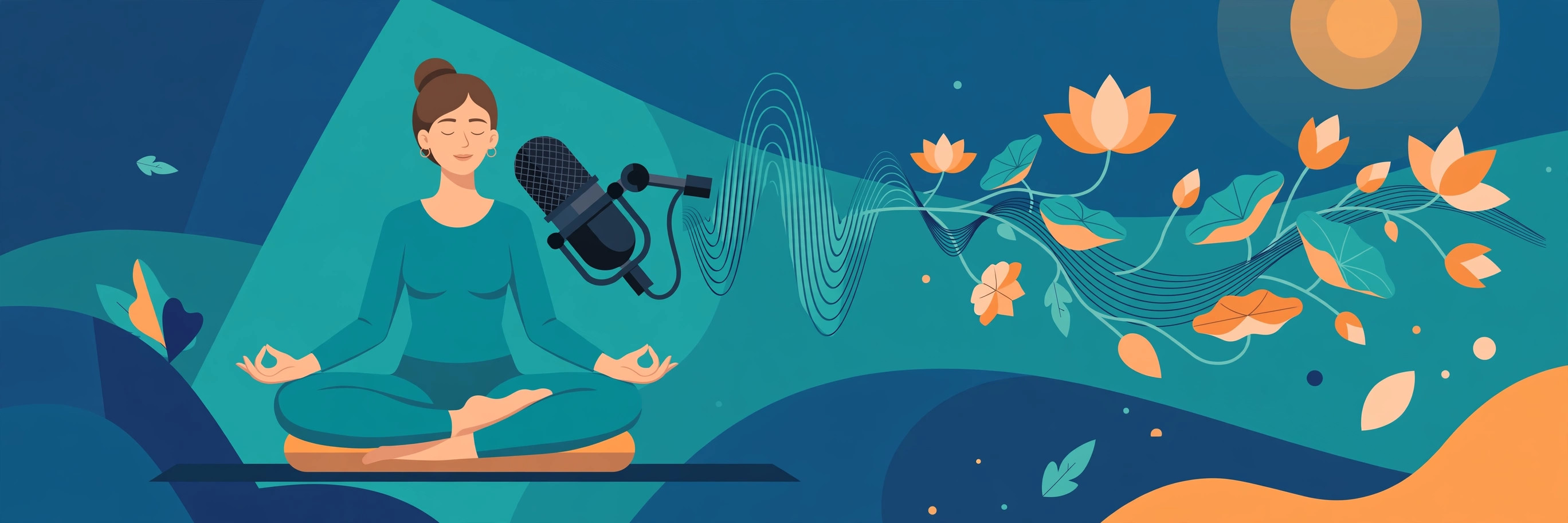
Your students already trust your voice in the studio. The slow cue to inhale, the pause before the exhale, the quiet reminder to soften the shoulders — that voice is the reason they come back. A podcast lets that same voice reach them wherever they are, long after class has ended.
Most yoga teachers assume a podcast means buying a microphone, learning audio editing, and finding hours they do not have. Text-to-podcast changes that equation completely. You write the words you would already say in class, and an AI voice turns them into a finished audio episode. No studio, no editing timeline, no retakes because a dog barked mid-recording.
TL;DR: Text to podcast lets yoga teachers turn written class scripts into audio episodes without recording or editing. Write a calm, cue-rich script, choose a warm AI voice, generate the audio, and publish it. One class script can become a guided session, a meditation, or a short teaching episode — at almost no cost.
What Is Text to Podcast for Yoga Teachers?
Definition: Text to podcast is the process of converting written text — a class script, a guided meditation, or a teaching note — into a finished audio episode using an AI voice, ready to publish on podcast platforms.
For a yoga teacher, the workflow is refreshingly simple. You already write class plans, sequences, and cues. Instead of reading them aloud into a microphone and spending an evening editing out the mistakes, you paste the text into a text-to-podcast tool, pick a voice that matches your teaching tone, and receive a clean audio file minutes later. The tool handles pacing, pronunciation, and audio quality. You handle the teaching.
This is different from recording yourself, and that difference is the point. A live recording captures every cough, every neighbour's lawnmower, and every moment you lose your place in the sequence. A text-to-podcast episode captures only what you wrote, delivered cleanly every single time. If you spot a better cue on Tuesday, you edit one sentence and regenerate — you never re-record the whole class.
Why Should Yoga Teachers Turn Classes Into Podcasts?
A yoga class ends when the mats are rolled up. A podcast episode keeps teaching all week. Students replay a guided relaxation before bed, practise a short morning flow while travelling, and share a breathing exercise with a friend who has never set foot in your studio. Every episode becomes a small, portable version of your teaching.
Podcasts also solve the reach problem every local teacher faces. Your studio holds twenty mats. Your podcast holds an unlimited audience, and it works while you sleep. A listener in another city — or another country — can discover your teaching style, trust your voice, and eventually join an online class, buy a course, or book a retreat.
There is a retention benefit too. Students who listen to your voice between classes stay connected to the practice. They arrive on Saturday already warmed up by your Wednesday episode.
What Kind of Yoga Content Works Best as a Podcast?
Not every class translates equally well to audio. The best podcast episodes are the ones where the voice carries the whole experience, and the student needs no visual demonstration. Short guided sessions, breathwork, meditations, and yoga philosophy all fit beautifully. A complex arm-balance workshop does not — students need to see that one.
| Content type | Podcast fit | Why it works |
|---|---|---|
| Guided meditation (5–20 min) | Excellent | Voice-led, eyes closed, no visuals needed |
| Breathwork and pranayama | Excellent | Cues and counting carry the whole practice |
| Gentle and restorative flows | Very good | Slow pace, simple poses, clear verbal cues |
| Yoga philosophy and talks | Very good | Storytelling and reflection suit audio perfectly |
| Short morning stretches | Good | Simple movements listeners already know |
| Advanced asana workshops | Poor | Students need to see alignment and transitions |
Start with what you already teach best. A ten-minute guided relaxation you run at the end of every class is a perfect first episode — you know the script by heart, the pacing is slow, and listeners will feel the benefit immediately. Breathwork episodes are a close second: a five-minute box-breathing practice is easy to write, easy to follow, and highly shareable.
Yoga nidra is another strong format. A twenty-minute body-scan script, delivered in a slow, even voice, is exactly what podcast listeners search for at bedtime. Philosophy episodes work too: a short talk on the meaning of ahimsa, or a story from the Yoga Sutras, gives listeners something to think about on a walk.
How Do You Turn a Yoga Script Into a Podcast Episode?
The process takes under an hour once you have done it twice. Here is the full workflow, from a blank page to a published episode.
- Pick one episode idea. Choose a single, focused topic — one guided meditation, one breathwork practice, one short flow. Narrow beats broad; a ten-minute episode on box breathing outperforms a forty-minute ramble every time.
- Write the script the way you teach. Use short sentences, plain words, and explicit cues: "Inhale for four counts. Hold for four. Exhale for six." Read it aloud once as you write — if a sentence is hard to say, it will be hard to hear.
- Mark your pauses. Add line breaks or ellipses where you want silence. A pause after "close your eyes" is part of the teaching, not dead air. Most text-to-podcast tools respect paragraph breaks as natural pauses.
- Choose a warm, slow voice. Pick an AI voice with a calm tone and a slightly slower-than-average pace. Preview it with your opening lines — if the first thirty seconds feel rushed or flat, try another voice before generating the full episode.
- Generate the audio. Paste the script, generate, and listen to the whole episode once. Check the pacing, the pauses, and any mispronounced Sanskrit terms. Fix the text — not the audio — and regenerate only the problem section if your tool allows it.
- Add a short intro and outro. Record or generate a fifteen-second opening ("Welcome to your ten-minute morning practice") and a closing that names your studio and where listeners can find you. Keep them identical across episodes so listeners recognise your show instantly.
- Publish to your podcast host. Upload the finished file, add a title, a one-paragraph description, and episode artwork. Your host distributes it to Apple Podcasts, Spotify, and everywhere else automatically.
The first episode is the slowest. By the third, the whole process — script to published episode — fits comfortably inside a single hour.
How Do You Keep a Yoga Podcast Calm and Listen-able?
Definition: Pacing in a yoga podcast means the speed and rhythm of the spoken cues — slow enough for listeners to breathe and move along, with deliberate pauses that let each instruction land before the next one begins.
Calm is a technical choice as much as a teaching one. The single biggest mistake new yoga podcasters make is writing scripts that read like a blog post: long sentences, packed paragraphs, and no room to breathe. On the page that looks thorough. In the ear it feels rushed, and rushed is the opposite of yoga.
Write in the rhythm you teach. One instruction per sentence. One sentence per line, if that helps you hear the pauses. "Lengthen your spine." Full stop. "Soften your shoulders." Full stop. The AI voice will follow your punctuation, so punctuation is your pacing tool. A comma is a short breath. A full stop is a longer one. A new paragraph is a real pause.
Finally, protect the sound itself. Generate your audio in a quiet file, avoid background music unless it is very soft and constant, and never let music compete with the voice. In yoga audio, silence is not empty space. It is the practice.
What Does It Cost to Start a Yoga Podcast With AI Voice?
One of the best things about text to podcast is how little it costs compared with a recording setup. A decent microphone, a quiet room, and editing software can easily run into hundreds of dollars before you publish a single episode. The AI route starts at zero.
| Option | Upfront cost | Monthly cost | Best for |
|---|---|---|---|
| Free AI voice tools | $0 | $0 | Testing your first 2–3 episodes |
| SynVoice pay-as-you-go | $0 | Usage-based | Regular weekly episodes, natural voices |
| Budget podcast hosting | $0 | $0–$15 | Distributing to Apple and Spotify |
| Home recording setup | $100–$300 | $0 | Teachers who prefer their own voice |
| Professional studio session | $150+/episode | — | One-off premium recordings |
Most yoga teachers can launch for nothing: a free tier of an AI voice tool for the audio, and a free podcast host for distribution. As the show grows, a small monthly spend buys better voices and longer episodes — usually far less than the cost of a single missed class.
How Do You Grow a Yoga Podcast Audience?
Your first listeners are already on your mat. Mention the podcast at the end of every class for the first month, and put the link in your class booking confirmation emails. Students who already trust your voice are the easiest subscribers you will ever win, and their early listens push your show up in podcast search results.
Next, make every episode easy to share. A five-minute breathing exercise is something a listener forwards to a stressed friend. A ten-minute sleep meditation gets shared in group chats at 10 p.m. Design at least one episode a month specifically to be shared.
Use your existing channels. Post the episode link on Instagram with a simple caption about what the practice helps with. Add it to your studio's WhatsApp group. Mention it in your newsletter with one line about the episode's benefit, not its title. People subscribe for the benefit — better sleep, calmer mornings — not for the episode number.
Finally, ask for the rating. At the end of each episode, one sentence is enough: "If this practice helped you, please leave a rating — it helps other people find the show." Early ratings are the single biggest factor in podcast discovery, and your students are happy to give them.
Can AI Voice Sound Warm Enough for Yoga?
This is the question every yoga teacher asks first, and it is a fair one. Yoga teaching is intimate. Your students know your voice, your pauses, your laugh. Can a synthetic voice really carry that?
The honest answer is: it depends on the voice and the script. A flat, fast voice reading dense paragraphs sounds like a GPS giving directions. A warm voice, set to a slow pace, reading a script written with short sentences and real pauses, sounds like a guided practice — because the warmth in a yoga class comes mostly from the words and the pacing, not from vocal imperfections.
Test it the way your students would: generate your opening minute with two or three voices and listen with your eyes closed. If your breathing slows and your shoulders drop, that voice works.
Many teachers use a hybrid approach: AI voice for the regular weekly episodes, and their own recorded voice for special episodes, retreats, and personal messages. Listeners accept both, because what they care about is the practice, not the production method. And if you ever decide to record yourself, your text-to-podcast scripts are already written — they become your recording scripts with no extra work.
Frequently Asked Questions
Do I need a microphone to start a yoga podcast with text to podcast?
No. Text to podcast needs no microphone, no recording room, and no audio editing software. You write the script, choose an AI voice, and receive a finished audio file. A microphone only becomes useful if you later decide to record your own voice for special episodes.
How long should a yoga podcast episode be?
Between 5 and 20 minutes works best for most yoga teachers. Short guided meditations and breathwork episodes of 5–10 minutes get the most replays and shares. Longer yoga nidra or philosophy episodes of 20–30 minutes suit a dedicated audience. Start short, and let listener feedback tell you when to go longer.
Can I use my existing class plans as podcast scripts?
Yes — class plans are the best starting material you have. Trim anything that needs a visual demonstration, shorten long explanations into single sentences, and add explicit pauses where you would normally wait for the class to settle. Most class plans need only light editing to become good podcast scripts.
Will my students mind that the podcast voice is AI?
Most will not notice, and those who do generally will not mind. What students care about is whether the practice helps them. If the pacing is calm, the cues are clear, and the teaching is yours, the voice fades into the background. You can also tell listeners openly that episodes are AI-narrated from your scripts — honesty builds more trust than secrecy.
How often should I publish new episodes?
Once a week is the sweet spot for most yoga teachers — frequent enough to build a listening habit, light enough to sustain alongside teaching. Twice a month also works if weekly is too much. Whatever you choose, keep the same day and time so listeners can rely on it.
Do I need to know Sanskrit to make a yoga podcast?
No. Use the Sanskrit terms you already use in class, and write them phonetically if needed so the AI voice pronounces them correctly — "oo-jah-yee" for ujjayi, for example. Many successful yoga podcasts use almost entirely English cues with only a few familiar Sanskrit words.
How do I get my yoga podcast on Spotify and Apple Podcasts?
Upload your finished audio to a podcast hosting platform, which distributes it to Spotify, Apple Podcasts, and other apps automatically. You only need a show title, a description, cover art, and your first episode. Approval usually takes a few days, and after that every new episode appears automatically.
Can a yoga podcast actually bring me new students?
Yes. A podcast is discoverable in a way a local studio is not — listeners find you by searching for "morning yoga" or "sleep meditation" and hear your teaching before they ever meet you. Teachers commonly see podcast listeners join online classes, buy recorded courses, and book retreats. The podcast is the first step of that journey, not the whole journey.
Start With One Episode This Week
You do not need a launch plan, a logo, or a content calendar. You need one script you already know — a ten-minute relaxation, a breathing practice, a short morning flow — and an hour to turn it into your first episode.
Write it the way you teach. Choose a warm voice. Listen once with your eyes closed. Then publish it, mention it in your next class, and watch what happens when your teaching keeps working after the mats are rolled up.
Your students already love your voice in the studio. Give them a way to carry it home.
Where to Go Next
These guides from SynVoice will help you go further:
- Learn the full workflow in our beginner's guide to text to podcast.
- See how another audience uses the same approach in Text to Podcast for Churches.
- Explore calm narration styles in AI Voiceover for Meditation Apps.
- Adapt written teaching into audio with Text to Podcast for Authors.