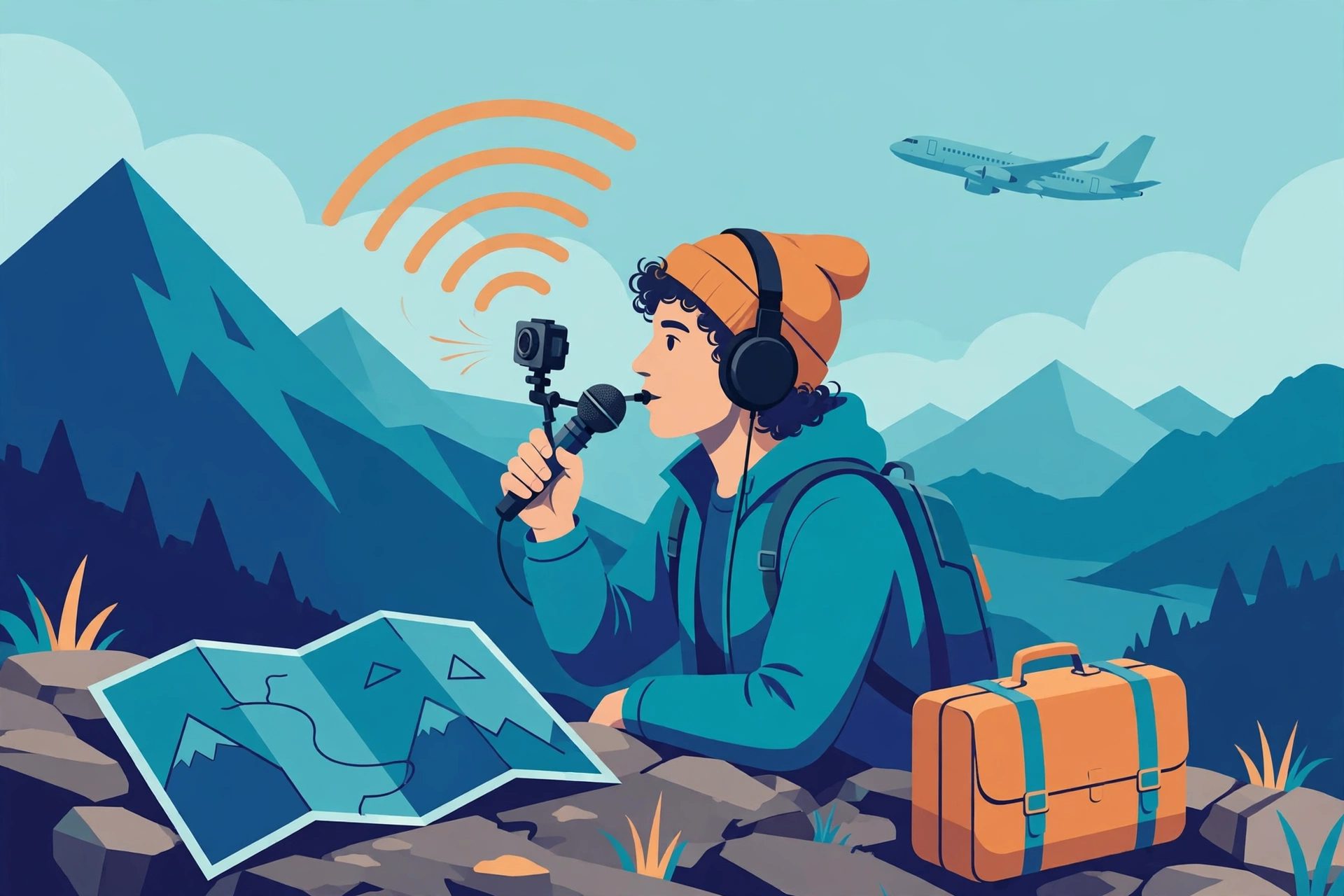
TL;DR: AI voiceover gives travel videos a clear, professional narration in minutes — no studio, no retakes, and easy re-voicing in other languages. It works best when the voice matches the trip's mood, the script is written for the ear, and the audio is checked end to end before publishing.
What Is AI Voiceover for Travel Videos?
Definition: AI voiceover for travel videos is human-sounding narration generated by artificial intelligence from a written script, used to guide viewers through destinations, tell the story of a trip, and explain what they are seeing on screen — without recording a human narrator in a studio.
Travel videos live or die by their narration. A beautiful shot of a mountain pass or a busy night market still needs a voice to tell the viewer where they are, why it matters, and what happens next. Until recently, that voice had to come from a presenter speaking into a microphone, often recorded in noisy conditions on the road or re-recorded later in a studio. AI voiceover changes that: a creator writes the script, picks a voice that fits the journey, and generates clean narration in minutes.
The result sounds like a calm, confident travel host — steady, warm, and consistent from the first scene to the last. It never gets tired, and it can be re-generated in seconds when the itinerary changes.
Why Do Travel Creators Use AI Voiceover?
Travel creators face a practical problem: the best footage is shot far from a quiet room. Wind on a mountain ridge, traffic in a city square, and the hum of a boat engine all ruin live narration. Recording later in a studio solves the noise but costs time and money, and every script change means another session.
AI voiceover solves four problems at once.
First, speed. A creator can finish a script in the morning and have finished narration by lunch. A ten-minute travel video that once needed a full day of recording can now be voiced in under an hour.
Second, consistency. A channel that publishes weekly needs the same voice in every video. Human narrators get colds and sound different after a long flight. An AI voice sounds identical in video one and video fifty.
Third, multilingual reach. Travel is a global topic, and the same video can reach viewers in Urdu, Hindi, Spanish, and English. Re-recording with human narrators in four languages is a major project; with AI voiceover it is the same script, translated and generated the same afternoon. Our guide to AI dubbing for video localization explains how creators expand one video into many languages.
Fourth, cost. A professional voice artist charges per finished minute, plus studio time. A creator publishing several videos a month can spend thousands of dollars a year on narration alone. AI voiceover costs a small fraction of that, which is why small travel channels can now sound as polished as large ones.
How Does AI Voiceover Work for a Travel Video?
Definition: AI voiceover for a travel video works by converting a written narration script into spoken audio with a trained voice model that controls pace, pauses, emphasis, and pronunciation — then syncing that audio to the video timeline in an editor.
The workflow has five stages. First, the creator writes the script for the ear, not the eye. Sentences should be short, place names spelled the way they sound, and each paragraph matched to one scene or shot.
Second, the creator chooses a voice — the most important decision in the process. It should match the mood of the trip: warm and relaxed for a beach holiday, energetic for a city adventure, calm for a documentary-style journey. The best creators test two or three voices with real viewers before committing.
Third, the script is generated as audio. The model predicts how each sentence should sound: where to pause before a reveal, how to emphasize a place name, and how softly to read a reflective line over a sunset shot. Producers can adjust the speaking rate and add explicit pauses — a two-second pause before a waterfall reveal makes the moment land.
Fourth, the audio is placed on the timeline. The narration is cut to match the footage, with music ducked underneath and natural sounds kept where they add atmosphere. A good edit leaves breathing room: narration should never fight the music for attention.
Fifth, the video is checked end to end by a human listener. Every place name, every pause, every transition is heard at least once before publishing. A mispronounced city name in a travel video tells viewers the creator did not do the research — the fix is a spelling adjustment in the script and a quick re-generation.
What Makes a Good Travel Video Voice?
Not every pleasant voice works for travel. The qualities that matter are specific, and worth testing before a voice becomes the sound of a channel.
Pace should match the footage. Slow, scenic shots of mountains and coastlines need a slower, more reflective voice. Fast city montages and adventure sequences need a brighter, quicker delivery. The same voice at a different speed can serve both — most AI voice tools let creators adjust the speaking rate per section.
Tone should fit the trip. A luxury resort video needs a smooth, polished voice. A backpacking adventure needs something warmer and more casual. A documentary-style journey through a historic city needs authority and calm.
Pronunciation must be flawless. Travel videos are full of place names in other languages: Lahore, Cappadocia, Hallstatt, Chefchaouen. A voice that mangles these names loses the trust of viewers who know the places. Creators should test every difficult name before generating the full script, and fix the spelling phonetically where needed.
| Voice quality | Why it matters for travel videos | What to test |
|---|---|---|
| Steady, natural pace | Gives viewers time to absorb the scenery | A 60-second scenic sequence with narration |
| Warm, confident tone | Makes the viewer trust the guide | Same script in two voices, ask viewers which felt more trustworthy |
| Clear pronunciation | Place names are the content — getting them wrong breaks trust | Every foreign place name before full generation |
| Adjustable energy | One voice should handle calm scenes and adventure scenes | Same voice at two speaking rates |
| Consistent delivery | Same voice in episode 1 and episode 50 | Compare the first and last minute of a long narration |
How Much Does AI Voiceover Cost for Travel Videos?
Definition: The cost of AI voiceover for travel videos is usually priced per character or per minute of generated audio, plus the editorial time to write and check scripts — typically a small fraction of the cost of hiring a professional narrator and studio for the same volume of content.
The numbers depend on volume. A creator publishing one video a week spends a modest monthly amount, while a channel producing daily content needs a bigger plan. Typical market ranges for a travel creator in 2026:
| Cost item | Typical range | Notes |
|---|---|---|
| AI voice generation | $10–$150 per month | Depends on minutes generated |
| Script writing and editing | Existing creator time | Writers already plan the video; audio adds a listening check |
| Human narrator comparison | $300–$1,500 per finished hour | Voice artist fee, studio time, and editing |
| Multilingual versions | Small extra per language | Same script translated, no re-recording |
| Studio and equipment | Near zero for AI audio | No recording booth needed |
The real comparison is the alternative: a narrator for every video, every language, and every update. A channel publishing four videos a month would pay thousands of dollars for human narration; the same volume with AI voiceover costs a fraction of that.
Which Travel Video Formats Benefit Most from AI Voiceover?
Some formats gain more than others. Knowing where AI voiceover shines helps creators spend their time on the formats that pay off.
Destination guides are the strongest fit. A guide to a city or region is mostly information — history, prices, best times to visit, where to eat — and that information is written before the trip. The narration can be generated from the finished script while the footage is still being edited.
Vlogs and trip diaries work well when the creator wants a reflective voice over footage shot on the move. The on-camera audio stays raw and authentic, while the AI voice carries the story between scenes.
Hotel and resort tours benefit from a polished, consistent voice that matches the luxury of the visuals. A calm, professional narration makes a property feel premium.
Documentary-style journeys need authority and clarity. AI voices with a measured, documentary tone handle long-form narration without tiring, and the same voice can carry a whole series.
Short-form travel clips for TikTok and YouTube Shorts need punchy, energetic narration in under a minute. AI voiceover generates these quickly, and creators can test several voice styles for the same clip. Our guide to AI voiceover for TikTok videos covers short-form pacing in detail.
How Do You Write a Travel Script for AI Voiceover?
Writing for the ear is a different skill from writing for the eye, and it decides whether the narration sounds natural or robotic.
Keep sentences short — one idea per sentence, rarely more than fifteen words. Long, complex sentences are hard for any voice, human or AI, to deliver cleanly.
Write place names phonetically where the voice might struggle. If the model says a name wrong, adjust the spelling in the script until it sounds right, then keep that spelling in a style note for the whole series.
Use contractions and natural speech patterns. "You will love this view" sounds better spoken than "One will find this view appealing." The script should read like something a friendly guide would actually say.
Mark pauses explicitly. A line like "And then… the valley opens up" needs the pause to land. Most AI voice tools accept pause markers, and a well-placed two-second pause is worth more than an extra adjective.
Match the script to the edit. Each paragraph should cover one scene, and the script should note where the scene changes. Creators who write the script after the rough cut — not before — get narration that fits the footage instead of fighting it.
Can AI Voiceover Handle Multiple Languages for Travel Content?
Yes — this is one of its biggest advantages for travel creators, because travel audiences are global by definition.
A video about the mountains of northern Pakistan can reach viewers in English, Urdu, and Arabic with the same footage and three narrations. A guide to Istanbul can be voiced in Turkish, English, and German. The cost of each extra language is a translation and a generation pass, not a new recording session.
The quality bar is pronunciation: each language version needs a native-sounding voice and a human check of the translated script. Machine translation of a travel script can produce awkward phrasing, so creators should have a native speaker review the text before generating audio. The same care applies to place names — a name pronounced correctly in English may need a different spelling in the Urdu version.
Creators who publish multilingual versions often see their biggest growth in the second language, not the first. A channel that starts in English and adds Urdu narration can reach an entirely new audience that was never served by English-only travel content. Our guide to AI voiceover for podcasts shows how the same multilingual approach works for audio-first content.
What Are the Common Mistakes in Travel Video Voiceover?
The most common mistakes are easy to avoid once creators know them.
Overwriting the script. Travel narration should guide, not lecture. A script that describes every detail of a scene leaves the viewer nothing to discover. Say less, and let the footage do the work.
Choosing the wrong voice. A bright, salesy voice over a quiet mountain sunrise feels wrong, and a slow, sleepy voice over a street-food adventure feels boring. Test the voice against the actual footage before committing to a whole series.
Skipping the listen-through. Every narration should be heard in full, over the finished edit, before publishing. Mispronunciations, awkward pauses, and timing clashes only show up in a full listen — never in a script read.
Ignoring background audio. Narration, music, and natural sound compete for the same space. Music should sit well under the voice, and natural sounds like waves or market noise should be kept where they add atmosphere and cut where they distract.
Forgetting the call to action. A travel video should end with a clear next step: subscribe, watch the next destination, or check the itinerary link. The narration is the best place for it, delivered in the same warm voice as the rest of the video.
Frequently Asked Questions
Is AI voiceover good enough for professional travel videos?
Yes, for most travel content. Modern AI voices sound natural over scenic footage and destination guides, and viewers rarely notice the difference. The key is a well-written script, a voice that fits the trip, and a full human listen-through before publishing.
How long does it take to add AI voiceover to a travel video?
A ten-minute narration usually takes under an hour from finished script to edited audio: a few minutes to generate, plus time to place it on the timeline and check it against the footage. Script writing is the slow part, not the voice generation.
Can AI voiceover pronounce foreign place names correctly?
Usually, with a little help. Most tools handle common names well, and creators can fix difficult names by spelling them phonetically in the script. Always test every new place name before generating the full narration.
Does AI voiceover work for YouTube Shorts and TikTok travel clips?
Yes, short-form travel clips are one of the best uses. The narration is short, punchy, and easy to regenerate in several voice styles, so creators can test which voice performs best with their audience.
How much does AI voiceover cost per travel video?
For a typical ten-minute video, the voice generation itself costs a few dollars or less on most plans. The real cost is the creator's time writing and checking the script, which is far less than hiring a professional narrator and studio.
Can I use the same AI voice for a whole travel series?
Yes, and you should. Using one consistent voice across a series builds channel identity, and viewers come to recognize it. Most tools let you save a favourite voice and reuse it for every episode.
Is multilingual AI voiceover worth it for travel channels?
For most travel channels, yes. Travel audiences are global, and a second-language version of a popular video often brings in a large new audience for the cost of a translation and one generation pass.
Do viewers dislike AI voices in travel videos?
Viewers dislike bad narration, not AI narration. A well-chosen voice with a good script and a careful edit is accepted by audiences; a robotic voice, a wrong tone, or a mispronounced place name is what draws complaints.